


If I were actually disciplined, I can tell you exactly what my weight-loss journey would probably look like.
I would exercise consistently, drink enough water, prioritize sleep, hit my protein goal most days, plan my meals instead of figuring them out when I was already hungry, and probably find more opportunities to move throughout the day.
I would make fewer impulsive food choices, I would be better about preparing for busy days, and I would probably lose weight faster as a result.
None of that information is particularly groundbreaking, and that’s actually the point. Most of us already know what we could be doing differently.
Knowing what to do and consistently doing it are two completely different things.
I think that distinction gets lost in weight-loss conversations because “discipline” is often treated like the answer to everything.
If you’re struggling, you need more discipline. If you’re not exercising, you need more discipline. If you’re eating in a way that isn’t supporting your goals, you need more discipline.
The implication is that the people who succeed are simply better at forcing themselves to do the things they don’t want to do, while the rest of us are somehow lacking a quality that everyone else managed to develop.
But real life is much more complicated than that.
Sometimes you genuinely don’t have the time or energy to do the thing you had planned. You may have worked all day, taken care of your family, dealt with a dozen unexpected problems, and reached the end of the evening with absolutely nothing left in the tank.
There are seasons when sleep is harder to prioritize, weeks when your schedule is completely upside down, and days when taking care of yourself means recognizing that you need to rest rather than adding another obligation to an already full day. That isn’t a lack of discipline. Sometimes that’s simply being a human being with a life that doesn’t revolve around weight loss.
Then there are the other times, and I think we should be honest about those, too. Sometimes you did have the time to take a walk and chose not to.
Sometimes you could have planned ahead but didn’t. Sometimes you stayed up scrolling even though you knew you would regret it the next morning, or you waited until you were starving to figure out dinner when you knew exactly what was going to happen if you did.
There are moments when “I’m too busy” is a legitimate explanation, and there are moments when it is just the explanation we would rather use than admit that something wasn’t important enough to us that day.
Learning to tell the difference is much more useful than calling yourself lazy.
That is where I think we get ourselves into trouble. We take a decision that happened on one particular day and turn it into a statement about who we are. You skip a workout and suddenly you’re “not consistent.” You have a weekend where you eat differently than you planned and decide you’ve “fallen off.” You don’t hit your protein goal for a few days and start wondering whether you’re even capable of doing this.
Before you know it, one imperfect stretch has become a reason to wait for Monday, the first of the month, or whatever other imaginary starting line feels clean enough to make us believe this time will be different.
You didn’t necessarily need to start over.
You just needed to continue.
That sounds obvious, but I think it is one of the hardest skills to develop in weight loss because we are constantly encouraged to think in terms of fresh starts. There is always another plan, another challenge, another Monday, another “reset.”
We convince ourselves that the next version of us will be more organized, more motivated, and more disciplined, when what we actually need is to figure out how the current version of us can keep going when things aren’t perfect.
And that matters because most people aren’t trying to become professional weight-loss participants. They’re trying to lose weight while continuing to live their actual lives.
If you have a job, a family, a relationship, a household to manage, social plans, travel, birthdays, holidays, responsibilities, or simply a brain that gets tired of thinking about food all day, your weight-loss strategy has to account for those things.
It can’t depend on you waking up every morning with unlimited energy and a completely empty calendar. It can’t require every meal to be planned perfectly or every workout to happen exactly when you scheduled it. If the only version of your plan that works is the version where everything goes according to plan, then the plan isn’t really designed for your life.
I know I could probably lose weight faster if I made weight loss the center of everything I do. I could spend more time thinking about meals, exercise, steps, macros, sleep, and all of the other variables that might make the process more efficient.
I could structure my days around getting the maximum possible result, and there is nothing inherently wrong with that if it is genuinely what someone wants. But I don’t want my entire life to become an optimization project.
I suspect a lot of you don’t want that either.
You want to lose the weight, but you also want to go to dinner with your friends without calculating every bite. You want to make progress, but you don’t want to spend your entire vacation thinking about what you should have done differently. You want to take care of your health, but you also want to have evenings where you sit on the couch and do absolutely nothing productive. You want your goals to matter without having to make them the only thing that matters.
That is not a lack of commitment.
That is a life.
The question becomes how we make progress inside that life instead of trying to eliminate everything that makes it messy.
Maybe that means recognizing that a twenty-minute walk is still worthwhile when you don’t have time for the workout you originally planned.
Maybe it means keeping a few easy, protein-rich foods around because you know there will be nights when cooking isn’t happening. Maybe it means going to bed earlier more often because you’ve noticed that being exhausted makes every other healthy decision harder.
And maybe it means accepting that there will be days when none of those things happen and deciding that one difficult day doesn’t deserve to become a difficult week.
The point isn’t to find another list of things you should be doing. Most people who are trying to lose weight already have plenty of those. The point is to understand your own patterns well enough to know what actually helps you continue.
WHAT I’M USING RIGHT NOW


→ Caribbean Freeze Clear Protein
Affiliate link. I may earn a commission if you purchase through my link.
That requires honesty, but it doesn’t require shame.
If you repeatedly find yourself skipping workouts because you don’t have enough energy after work, that’s useful information. Maybe the answer isn’t to demand more discipline from yourself at 7 PM. Maybe your schedule needs to change, or your expectations need to change, or you need to find a form of movement that doesn’t require quite so much energy.
If you consistently get to dinner starving because you didn’t eat enough during the day, that is also information. It might mean your daytime meals need more substance rather than you needing to become “better” at resisting food at night.
Sometimes the solution to a behavior isn’t more willpower. Sometimes the solution is making the behavior easier.
And I think that is one of the biggest things we miss when we talk about discipline. We act like the answer is always to try harder, when sometimes the smarter approach is to build an environment where you don’t have to fight yourself quite so much.
That doesn’t mean every obstacle can be solved with better planning. Some weeks are simply hard. Some seasons of life leave you with less capacity than you’d like. There will be times when your health has to share the spotlight with everything else you are responsible for, and pretending otherwise isn’t going to make you more successful.
The goal isn’t to eliminate those seasons. It’s to learn how to move through them without deciding that your entire journey is over.
There is also a certain amount of freedom that comes from admitting when you simply made a choice that wasn’t aligned with your goal. You don’t have to explain it away, and you don’t have to punish yourself for it. You can recognize that you could have made a different decision, decide whether there is anything worth learning from it, and then move on. That is very different from telling yourself that you’re incapable of changing.
Because you’re not.
You are allowed to be inconsistent sometimes and still become more consistent over time. You are allowed to have habits that need work without deciding that you are the problem. You are allowed to want to lose weight and still have days when weight loss isn’t the most important thing happening in your life.
And you are allowed to be honest about the fact that sometimes you really could have done better.
I think that honesty is actually more empowering than pretending every choice was unavoidable. If you always blame your schedule, your metabolism, your cravings, your busy week, or whatever else is convenient, you never have to take responsibility for the things you actually can change.
But if you blame yourself for everything, you end up exhausted and ashamed and no closer to understanding what is actually happening.
There has to be something in between.
Sometimes you need to give yourself some grace because life genuinely asked more of you than you had to give. Other times, you need to recognize that you have been using the same excuse for six months and perhaps it is time to do something differently.
Both can be true, and learning to recognize which one you’re dealing with is part of the work.
So when you catch yourself thinking, “If I were actually disciplined, I would be doing all of these things,” I want you to pause before turning that thought into another reason to feel bad about yourself.
Ask yourself whether the thing you’re struggling with is actually important to your goals, whether your expectations are realistic for the life you’re currently living, and whether there is a smaller or easier version of the habit that you could actually sustain.
If there is something you genuinely need to change, change it. If you’re asking yourself to do something that doesn’t fit your current reality, adjust it. And if you simply made a choice you wouldn’t make again, let yourself learn from it without turning it into a referendum on your character.
Weight loss does not require you to become a perfectly disciplined person.
It requires you to keep making choices that support your goals often enough for them to add up, while accepting that real life is going to interfere sometimes.
The people who make it through the messy middle aren’t necessarily the people who never struggle. They are often the people who figure out how to keep going without requiring themselves to be perfect first.
And maybe that’s a much more useful version of discipline anyway.
Not forcing yourself to do everything.
Not turning every meal, workout, or weigh-in into a test of your worth.
Not waiting for the perfect Monday when you can finally “get serious.”
Just being honest about what is working, honest about what isn’t, and willing to make the next adjustment without deciding that you have to become an entirely different person to succeed.
Because you don’t need a more disciplined version of yourself to start making progress.
You need a version of your life that makes progress possible.
see you tomorrow,
Nyk
Want to do this with us instead of doing it alone?
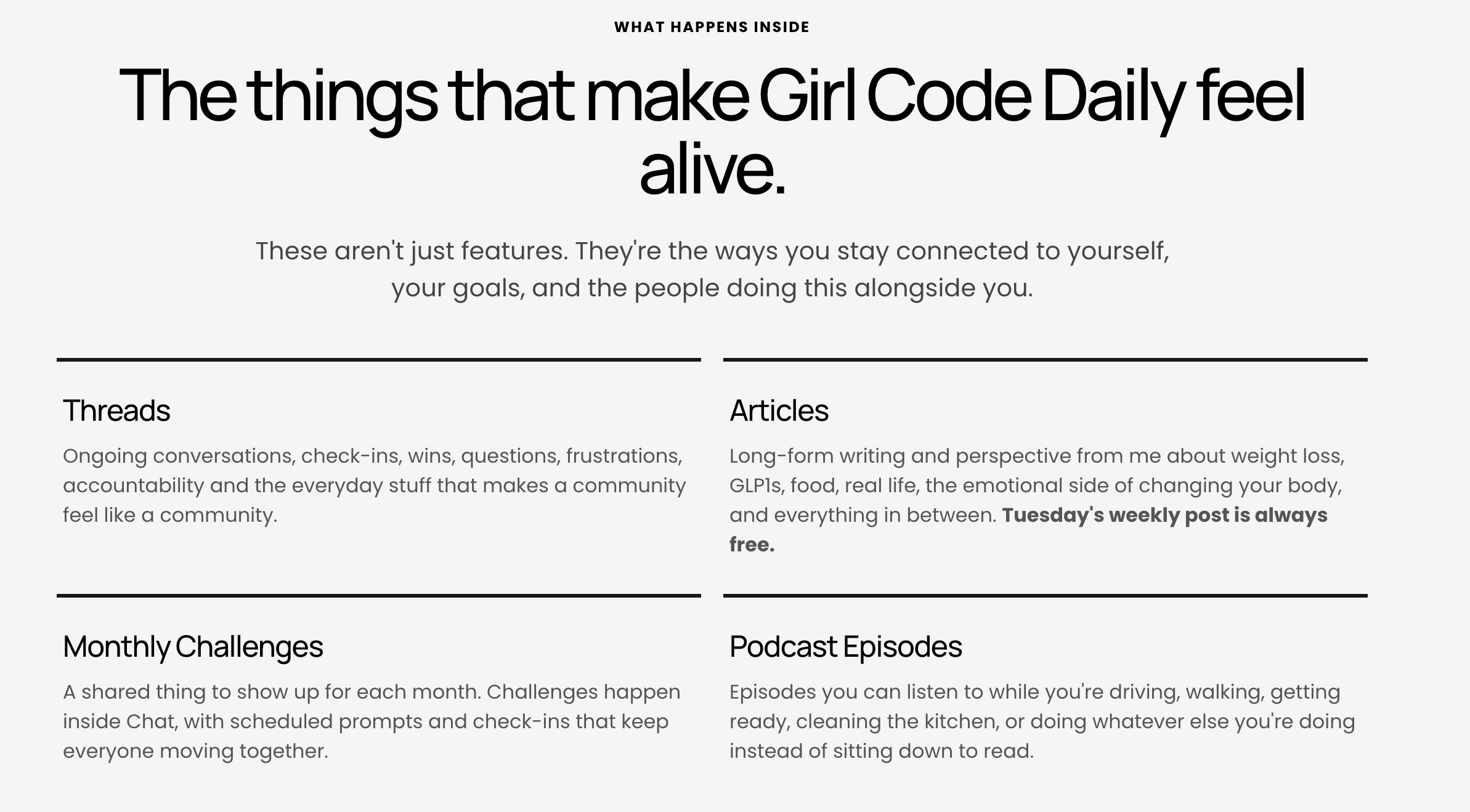
Girl Code Daily is where we’re actually putting all of this into practice together. We have community threads where you can check in, talk about what’s working, admit when it’s absolutely not working, and be around other women and men who are figuring out weight loss in real life, too.
We also do monthly challenges, member-only bonuses and downloads, and right now we’re heading into our October steps challenge, where the goal isn’t some magical perfect number. It’s simply to intentionally move more than you are right now.
You can join Girl Code Daily for $5.99/month or $40/year, and there’s a free trial if you want to come see what we’re building.
And if you’re not ready to join, you can still help Girl Code Daily grow. Restack this post or send it to someone who has ever wondered why knowing exactly what to do somehow doesn’t make doing it any easier. It helps more people find us, and I appreciate it more than you know.