

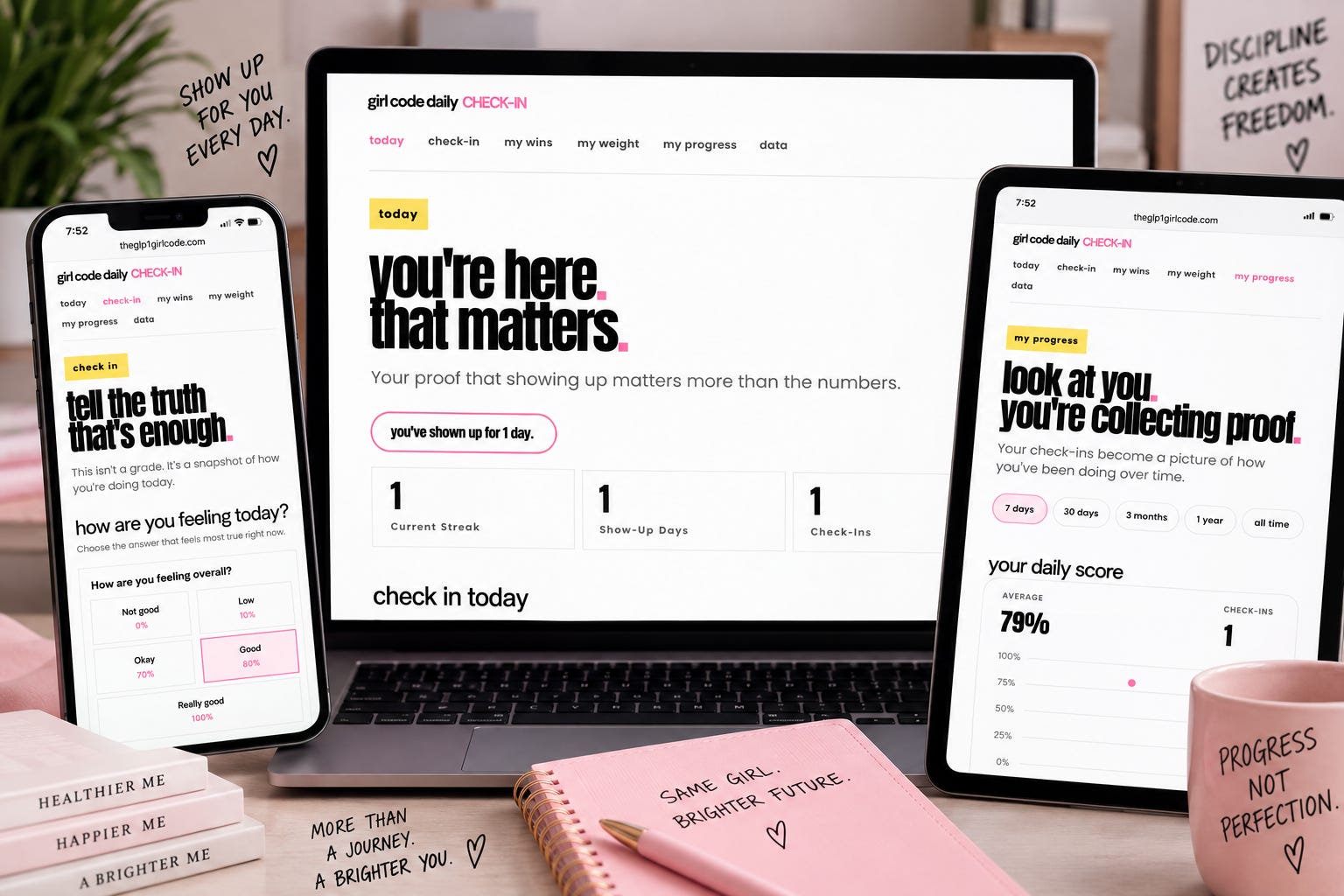
There is a very specific kind of frustration that happens when you’ve been working on yourself for a long time and realize you have somehow collected an absurd amount of data about your body while knowing surprisingly little about how you actually feel.
I can tell you how much I weigh. I can tell you how much I’ve lost. I can tell you where I started, where I want to go, and how many pounds stand between me and that goal. I can track food, protein, workouts, steps, medication, sleep, measurements, and probably seventeen other things if I really want to make myself miserable. 😂
There is no shortage of things willing to tell us how we’re doing.
The problem is that most of them are measuring an outcome.
And weight loss, especially when you’re doing it for months or years, is not just an outcome. It’s a life you’re living while the outcome is happening.
There are weeks when the scale moves and you feel fantastic. There are weeks when the scale doesn’t move and you still did things you’re incredibly proud of. There are days when your motivation is through the roof and days when you’re dragging yourself through the most basic parts of your routine. There are periods where you’re sleeping better, feeling calmer, feeling more in control, and realizing something has changed long before you can put a number on it.
What if we paid attention to all of that, too?
That is the question that eventually became the Girl Code Daily Check-In.
And today, I’m opening the BETA to you.
Not because I think I’ve built the perfect dashboard.
Quite the opposite.
I’ve built the first version of something I’ve been thinking about for a long time, and now I want to put it in your hands and see what happens.
I didn’t want to build another tracker
There are already countless apps that will happily let you track every measurable part of your existence.
Calories. Protein. Water. Steps. Workouts. Weight. Measurements. Sleep. Medication. Blood pressure. Heart rate. Macros. You can probably find an app that will track how many times you remembered to breathe today if you look hard enough.
And I’m not saying those things are useless. Some of them can be incredibly helpful. I use tracking in my own life because I like having information, and I think there is real value in knowing what you’re eating, understanding your habits, and being able to look back at your progress.
But I didn’t want Girl Code Daily to become another place where you have to perform wellness correctly.
That distinction matters to me.
Because I know what happens when tracking gets out of control. Something that was supposed to make your life easier starts becoming another job. You miss a checkbox, so you feel behind. You don’t hit your goal, so you feel like the day didn’t count. You have one imperfect day and suddenly the entire week feels ruined.
I didn’t want that.
I wanted something that made you want to come back tomorrow.
So instead of asking you to track every possible behavior, I wanted the dashboard to ask you something much simpler:
How are you doing?
The eight questions are the point
Every day, the dashboard gives you eight questions.
How is your overall mood?
How is your energy?
How stressed are you?
How do you feel about your sleep?
How motivated do you feel?
How anxious do you feel?
How in control do you feel?
How focused do you feel?
That’s it.
And yes, I know there are probably another thirty things we could add.
That’s exactly why I don’t want to.
Because the simplicity is intentional.
I don’t need to know every detail of your day to help you start noticing patterns in your life. I don’t need to know exactly how many steps you took before I can understand that your energy has been feeling better lately. I don’t need another spreadsheet full of numbers to tell me that stress has been higher for the last few weeks.
The check-in is designed to create a snapshot.
Not a diagnosis. Not a judgment. Not a report card.
Just a moment where you stop long enough to say, This is where I am today.
At the end, those eight answers create your Your Day score, but please don’t turn around and make that number another thing you need to “win.”
A 90 isn’t a morally superior day to a 62.
A 62 might have been a really hard day where you still showed up.
The score is information, not a grade.
That might be the most important piece of this entire thing.
