

I was actually a small kid.
Not thin in a way that needed to be noticed. Just... normal. Little. The kind of kid who didn’t take up much space.
I need you to know that before I tell you the rest. Because what happened next had nothing to do with my body. It had everything to do with one woman’s perception of it, and the 30 years I spent believing she was right.
The Year Everything Changed
When I was in first grade my mom blew up our family.
She was having an affair with her best friend’s husband. When it came out, everything fell apart. She left. We got split up. Me and my older brother went to live with my nana and popo in El Paso. My little brother was sent to San Antonio. My mom went to Tennessee with the man she chose over all of us.
A whole year. Seven years old. No mom. No little brother. Just my grandparents and the life they quietly built around us to make sure we felt okay.
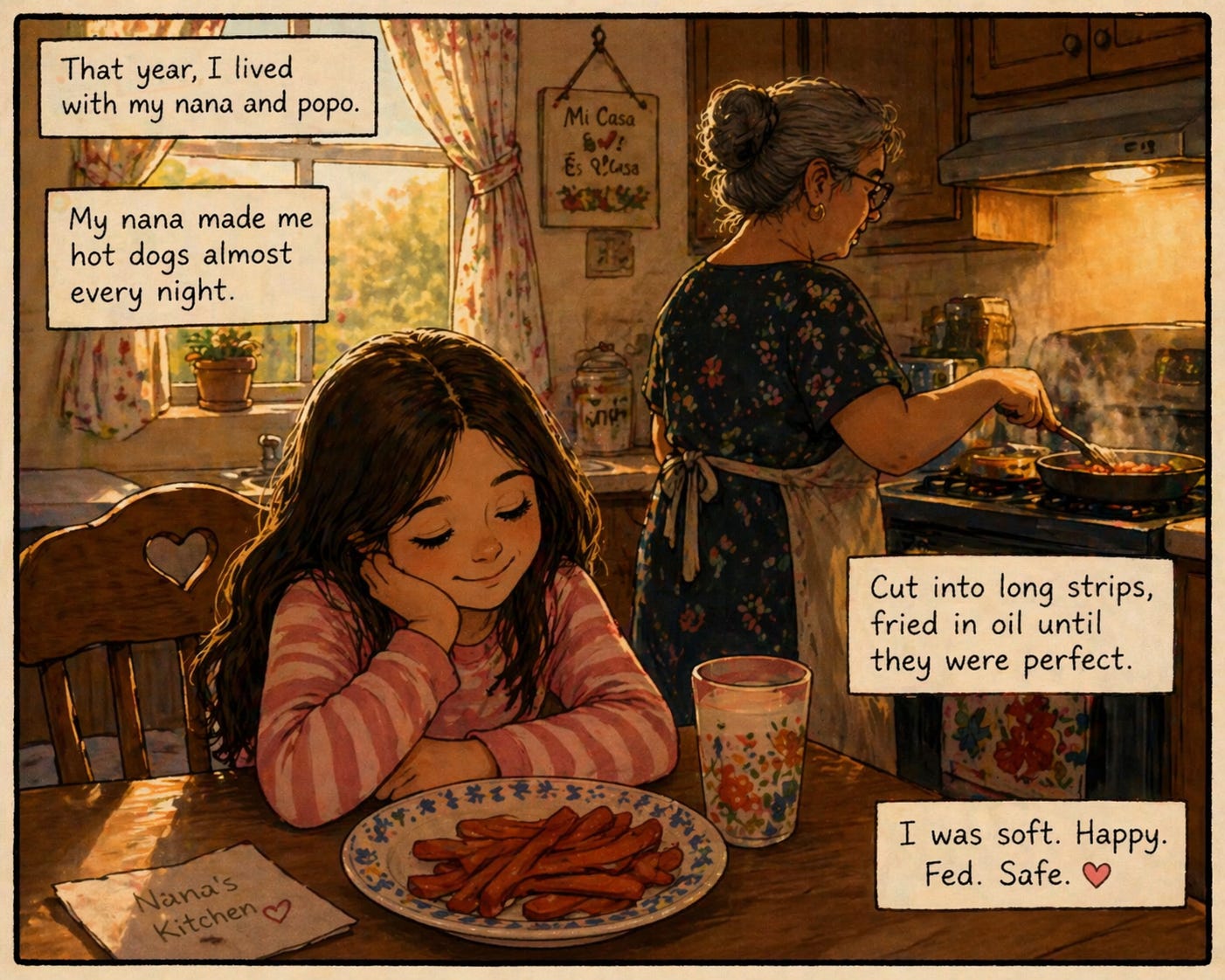
My nana made me hot dogs almost every night. Cut into long strips, fried in oil until they were perfect. I was a picky eater and I loved them and she made them because that’s what it looks like when someone actually loves you without conditions.
I gained a little weight that year. Not much. Not even close to overweight. Just a normal kid who ate comfort food because she was living through something confusing and painful and nobody had given her the language to understand any of it.
I was soft. Happy. Fed. Safe.
And then my mom came back.
The Comment
She noticed immediately.
I don’t remember her exact words. She will tell you to this day she never called me fat. That she doesn’t know what I’m talking about. That I’m remembering it wrong, that she would never say that, that I’m being dramatic. She has been making that argument my entire life.
But here is what I know to be true.
She made comments about my belly. About my body. About how my nana had fed me too many hot dogs. She looked at her seven year old daughter, who had just spent a year without her mother, who had just been through more upheaval than any child should have to navigate, and the thing she chose to address was my stomach.
I was in second grade, and I heard with complete clarity: your body is a problem. You are a problem. Fix it.
That was the moment. That was when the noise started.
What She Was Doing to Herself
Around this same time my mom was in the middle of her own obsession.
She had lost weight fast. Gotten thin. And she became completely fixated on staying that way, on how she looked, on how everyone around her looked. I know now that she was drinking. I know now there were other things going on. But as a kid all I saw was a mother who was always watching. Always commenting. On her body. On my body. On my friends’ bodies when they came over. It was constant and relentless and completely normal to me because it was all I knew.
I grew up marinating in her voice. The way she talked about food like it was dangerous. The way she talked about bodies like they were projects. The way she looked at mine like it was something she needed to manage.
I absorbed every single bit of it.
The Lie I Believed for 30 Years
Here is the truth that took me until my mid thirties to understand.
I was not overweight as a child. I was not overweight in middle school. In high school I was maybe 130 to 140 pounds at 5’2, right on the edge, but I was a teenager with a normal body living a normal life and doing normal things.
But my best friends were 100, 110 pounds, tiny, and my mom made sure I understood the difference. So I spent my entire adolescence convinced I was enormous. Convinced my body was the wrong shape. Convinced that I needed to earn the right to eat the things I loved by being smaller than I was.
That is not something a child comes up with on her own. That is something a child is taught. And once it’s in there, once that voice takes up residence in your head at seven years old, it does not leave just because the person who put it there eventually stops talking.
She Left. The Voice Didn’t.
This is the part that I think about the most.
My mom was not a consistent presence in my life. I spent most of high school living with my grandparents because her lifestyle wasn’t safe or stable enough for me to be around. There were years of chaos. Years of her being almost unreachable. Years of me watching her choose everything else over her kids and still somehow hoping the next time would be different.
She wasn’t there. But God, her voice was.
Every diet I tried in my twenties. Every time I stood in a dressing room under fluorescent lights. Every meal where I ate something and immediately felt the spiral start. Every morning I woke up and the first thought I had was about my body and what I did wrong yesterday. That was her. Living rent free in my head, long after she’d moved on, long after the comments stopped, long after she’d rewritten the whole story into something she could live with.
She got to forget it. I didn’t.
What 14 Years of Dieting Actually Did
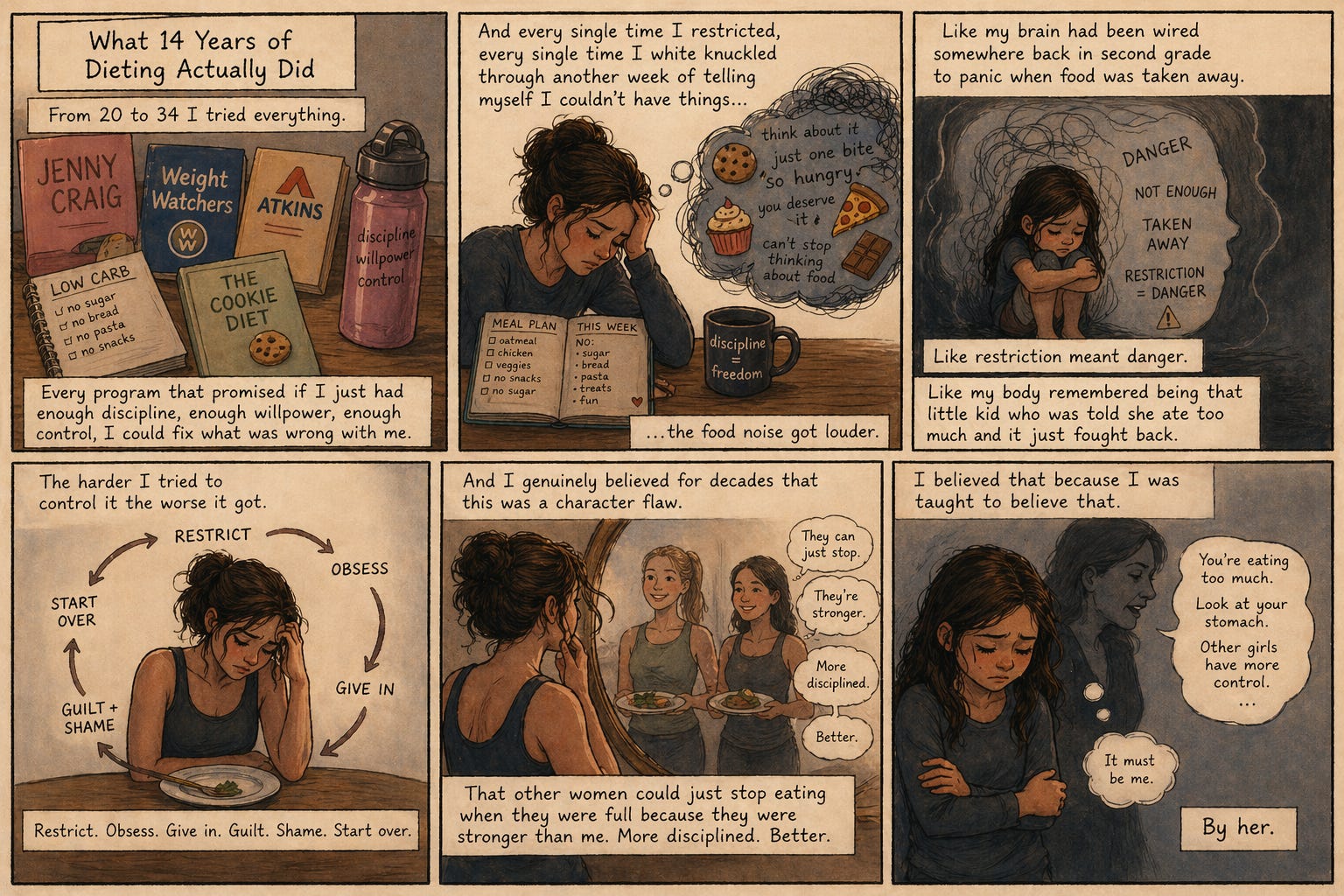
From 20 to 34 I tried everything. Jenny Craig. Weight Watchers. Atkins. Low carb. The cookie diet. Every program that promised if I just had enough discipline, enough willpower, enough control, I could fix what was wrong with me.
And every single time I restricted, every single time I white knuckled through another week of telling myself I couldn’t have things, the food noise got louder. Like my brain had been wired somewhere back in second grade to panic when food was taken away. Like restriction meant danger. Like my body remembered being that little kid who was told she ate too much and it just fought back.
The harder I tried to control it the worse it got.
And I genuinely believed for decades that this was a character flaw. That other women could just stop eating when they were full because they were stronger than me. More disciplined. Better. I believed that because I was taught to believe that. By her.
What I Know Now That I Wish I’d Known Then
Food noise is not a willpower problem. It is not a discipline problem.
For a lot of us it is a trauma response that got hardwired into our nervous systems before we were old enough to understand what was happening to us. When someone teaches you at seven years old that your body is wrong, your brain learns to be afraid. Afraid of food. Afraid of fullness. Afraid of taking up space. Afraid of being seen. And fear does not respond to meal plans. It does not respond to point systems or calorie deficits or any amount of white knuckling.
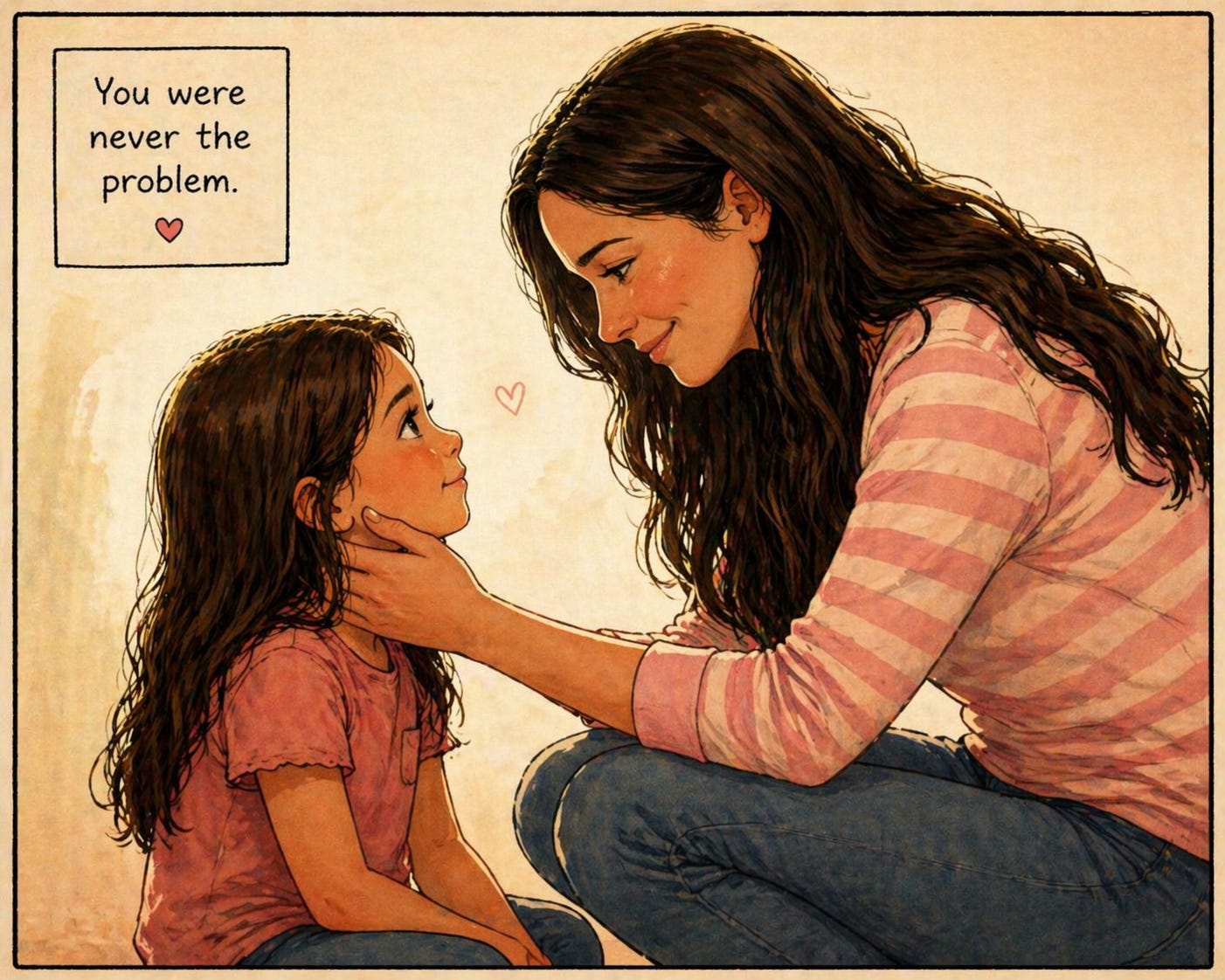
It responds to safety. To being told, maybe for the first time, that you were never the problem.
GLP-1 quieted the noise enough for me to finally hear that. Not because it fixed any of the emotional weight I was carrying, but because when the food noise softened I finally had enough space and silence to look back and understand where it came from. And what I saw when I looked back was a little girl who just wanted hot dogs. Who gained a little weight at her nana’s house during one of the hardest years of her life. Who came home to a mother who should have held her and instead looked at her stomach.
That little girl didn’t need to be fixed. She needed to be loved exactly as she was.
She Still Won’t Admit It
I want to say this clearly because I think it matters.
My mom knows how I feel. We have had versions of this conversation. And every single time she finds a way to reframe it, minimize it, or turn it into a misunderstanding. She never said fat. She doesn’t remember it that way. She was doing her best. I’m too sensitive.
I’m not writing this to destroy her. I’m writing this because I spent 30 years protecting her feelings at the expense of my own healing, and I’m done doing that.
What she said mattered. The way she made me feel about my body mattered. The fact that she can’t hold that accountability doesn’t make my experience less real. It just means I have to do the healing without her participation.
Which is maybe the hardest thing about this kind of wound. You don’t always get the apology. You don’t always get the acknowledgment. Sometimes you just have to grieve the mother you deserved and figure out how to put yourself back together anyway.
I’m still doing that. Actively. At 37 years old.
For the Woman Reading This Who Recognizes Herself
Maybe it was your mom. Maybe it was someone else entirely. A dad. A grandparent. A coach. A friend who said one thing one time that lodged itself so deep you can still hear it decades later.
Whoever it was, I want you to hear this.
You were not too much. You were not a problem to be managed. Your body was not something that needed to be fixed or shrunk or apologized for. You were a child who deserved to be seen and loved and fed without conditions.
The fact that you didn’t get that is not your fault. It was never your fault.
The noise you’ve been carrying was never yours to carry. You just didn’t know yet that you could put it down.
In this week’s paid post I’m going to talk about my daughter.
About what I’m doing differently. About the moments where I catch my mom’s voice trying to come out of my mouth and what I do instead. Because breaking a cycle that started 30 years ago is its own kind of work. And I think a lot of you are doing it too.
That one’s coming Friday. For paid subscribers.

Hunger = Fear (fight to not eat)
Fullness = Failure (lost the battle to eat). My mother also let me know at a young age that I was flawed because I was not svelte. Weight Watcher meeting started at 10, stomach staple in my 20’s, Fen-Phen in my 30’s, bulemia throughout and gastric by-pass in my 40’s. I discovered GLP-1 in my 60’s, and there I discovered life, wonderful life. But, I often wonder if my mother had loved me no matter how I looked, provided that sense of safety, if I could have found the life I’m living now decades earlier. One more thing, I did not follow my mother’s path with my own children. I’m proud of that.
Wow. That's rough. I'm fortunate enough that my family structure was stable and that my parents were overtly loving. That being said, I still heard those messages that my body was too big from my mom starting in middle school. They weren't loud, but they were there. Add that to growing up in the 80s, and my brain got royally screwed up. I'm 58 years old and have spent the last few years working hard to love my body, but it's hard. My mom and I have talked about my childhood, but she doesn't see that there were any issues in how here disordered eating or view of my or her or anyone else's body was a problem. I've been on tirzepatide for a month now and am starting to feel what life is like to not always think about food. It's liberating. I hope we can all learn to love ourselves and take care of our bodies and be healthy, even if we need medications.