Let me start with something nobody says out loud:
Most women on GLP-1s are measuring themselves against made-up numbers.
Not doctor numbers. Not research numbers. TikTok numbers. Instagram numbers. The woman in the comment section who swears she lost 30 pounds in 8 weeks. And because of that, millions of women are looking at real, legitimate, clinically supported progress and deciding it means something is wrong with them.
That is the problem we’re solving today.
Wait, What’s the 20% Rule?
This isn’t a wellness blogger’s formula. It comes from the largest GLP-1 clinical trials ever run.
In the SURMOUNT-1 trial, participants on tirzepatide lost:
15% of body weight on 5mg
19.5% on 10mg
20.9% on 15mg
That was over 72 weeks. Not 12. Not 16. Seventy-two.
The STEP trials for semaglutide showed an average of 14.9% over 68 weeks.
And here’s what the headlines always leave out: those participants had structured support. Movement plans. Regular check-ins. They weren’t just taking a shot every week and hoping for the best. They had an entire protocol built around them.
So the ceiling most people are chasing? It was built in a controlled environment most of us will never have access to. And it still took over a year.
The Math Nobody Does
This is where it gets real, and where I want you to actually stop and do this for yourself.
Take your current weight. Not your starting weight. Right now, today.
Multiply by 0.20.
That’s your realistic expectation for the next 12 months.
Divide that number by 12 for a monthly average. Divide that by 4 for weekly.
Here’s what that looks like across a range of weights, because your number is yours and nobody else’s:
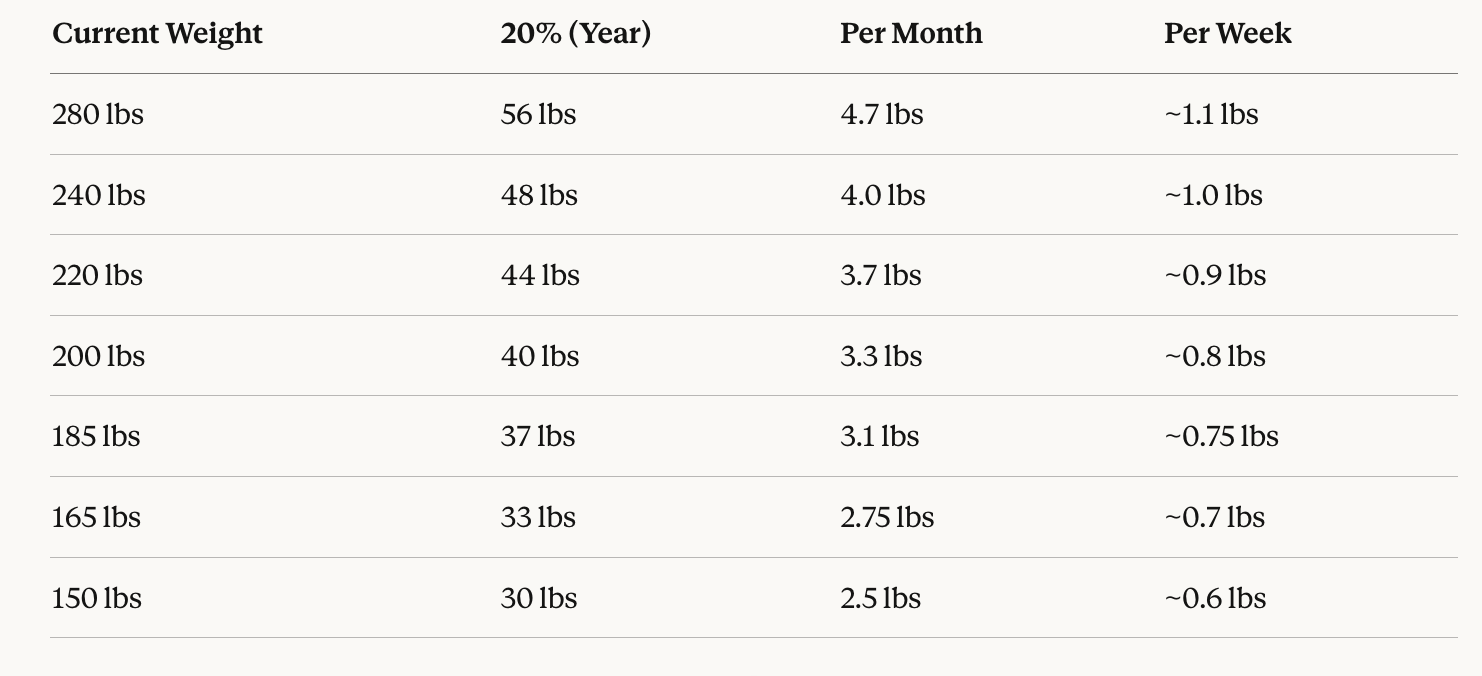
Find your number. That is what success looks like for your body right now.
I’m at 185. My 20% is 37 lbs over a year. That’s 3.1 lbs a month. That’s less than a pound a week. And that is still a win, a real one, backed by real research.
Why Lower Starting Weights Change Everything
This is the part I really want to sit with you on, because I don’t see people talk about it enough.
The further along you are in your journey, the smaller your numbers get. That’s not failure. That’s physiology.
If you started at 280 and you’re now at 185, your monthly average dropped from 4.7 lbs to 3.1 lbs. Same medication. Same effort. Smaller number. Because your body has less to give up now.
Some months you’ll hit your average. Some months you’ll lose 1 lb and feel like you’re broken.
You’re not broken. You’re just further along than your expectations have caught up to.
The women losing 4, 5, 6 lbs a month are often earlier in their journey, at higher starting weights, with more room to move. That’s not a better outcome. It’s just a different starting point.
Comparing your chapter 9 to someone’s chapter 1 will wreck you every single time.
What Happens When Expectations Are Wrong
I’ve watched this pattern so many times in this community, and I’ve lived it myself.
Week 1: down 3 lbs. Thrilled. Week 4: down 0.6 lbs. Spiraling. Week 6: “this medication isn’t working for me.”
And then they quit. Or they increase their dose before their body is ready. Or they start restricting so hard that they lose muscle instead of fat and then wonder why the scale won’t move.
All of it, every single bit of that, comes from an expectation that was never grounded in reality.
When you know your number, slow weeks stop being scary. A 0.6 lb week isn’t a failure. It’s a data point. It’s one week in a 52-week year. It counts. It adds up.
The Boring Truth About Sustainable Loss
Here’s what I’ve learned being over a year into a plateau while still moving toward my goal:
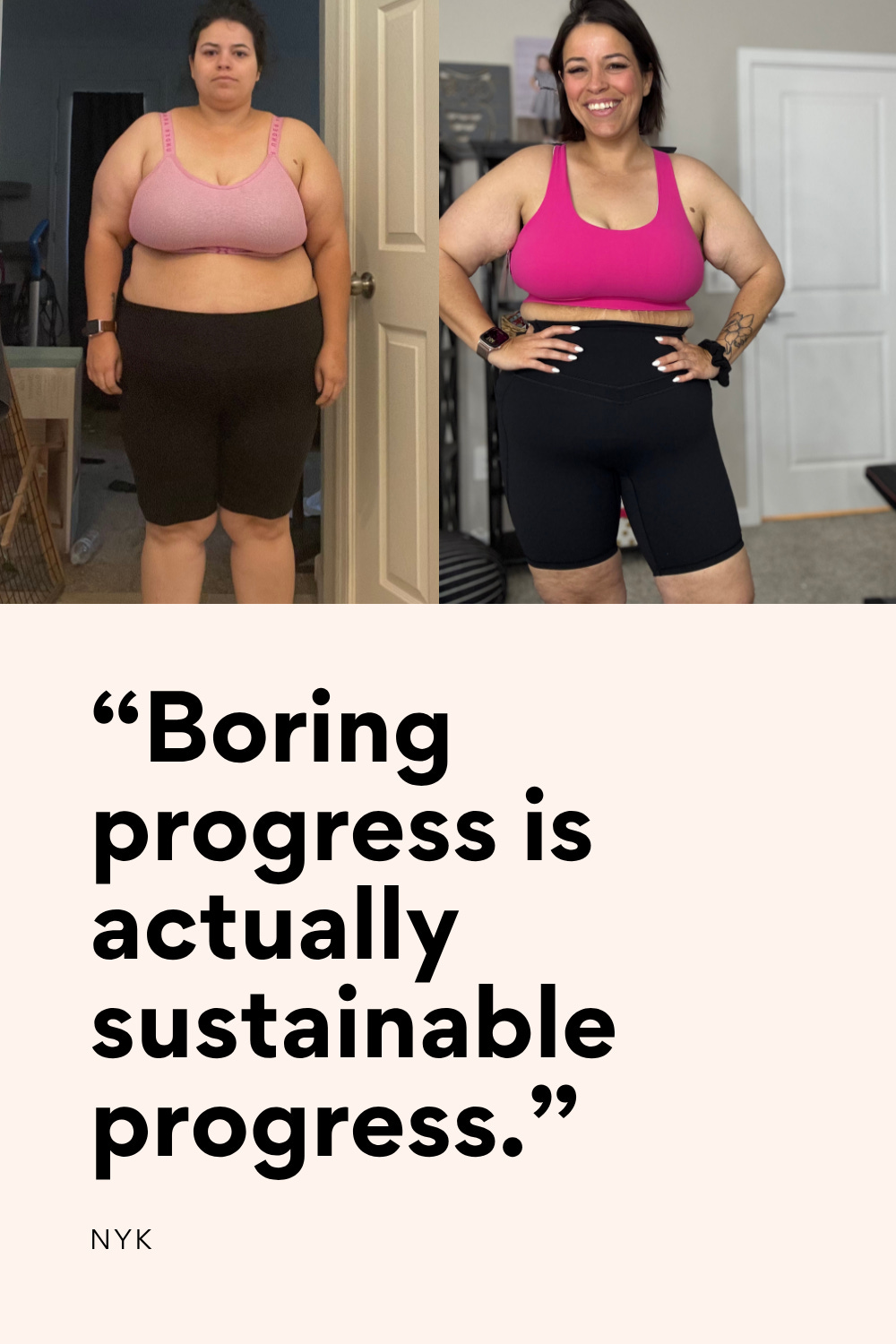
Boring is good.
Boring means your body isn’t in crisis. Boring means you’re not white-knuckling it. Boring means the changes you’re making have become normal enough that they’re not dramatic anymore.
That’s the whole point.
You’re not supposed to be in a transformation arc forever. At some point the transformation just becomes your life. And when you’re living it instead of performing it, the scale reflects that. Slowly. Quietly. Consistently.
That is a win. Even when it doesn’t look like one on camera.
Your One Action from This
Do the math. Write the number down somewhere you’ll see it.
Not as a goal to hit by a certain date. As a reminder of what good progress actually looks like for your body, at your weight, right now.
And the next time you’re about to spiral over a slow week, come back to that number. Ask yourself: am I still inside my 20%?
If yes, you’re doing it. Keep going.
First time seeing me?
Here’s the best way to get caught up on my story.