

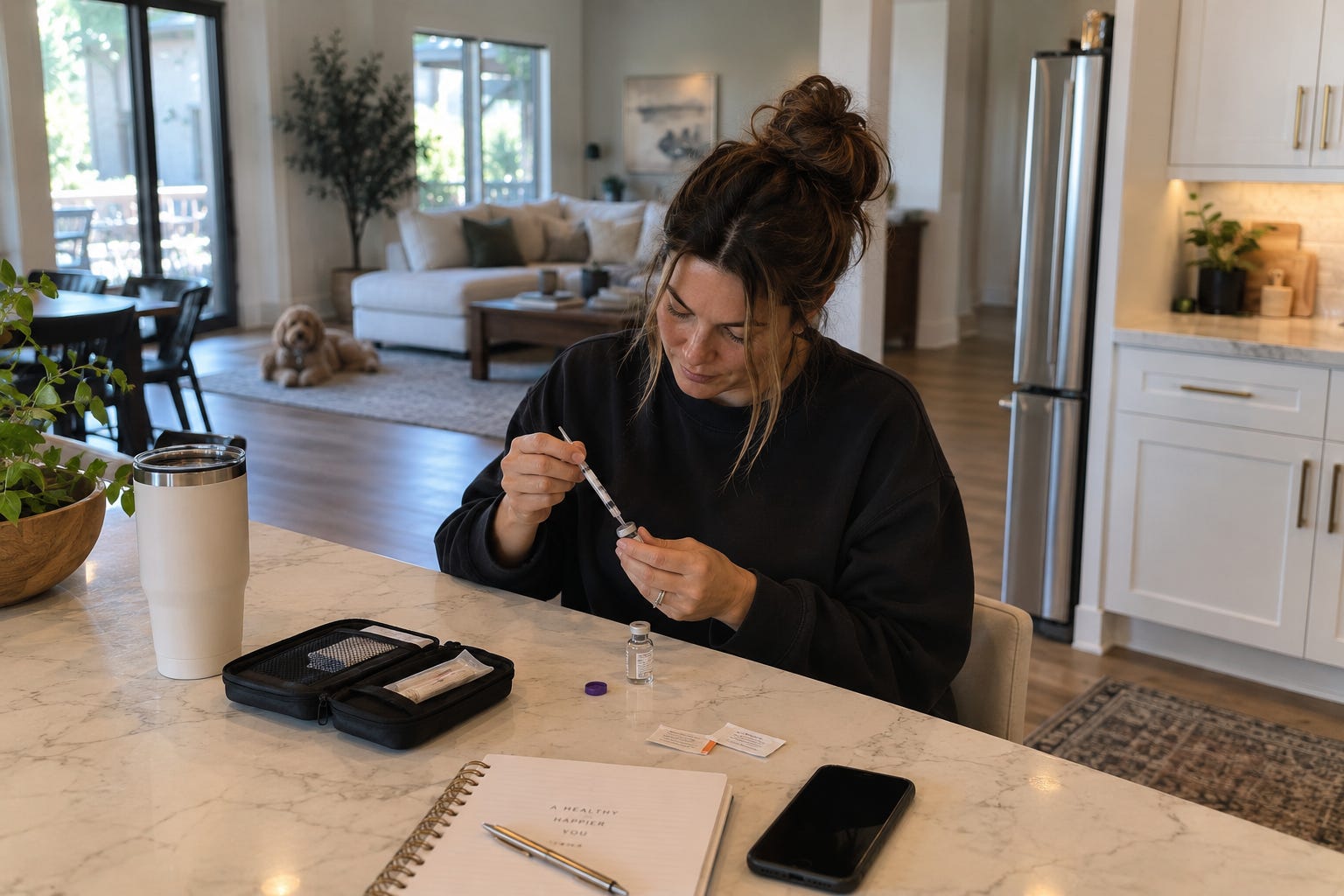
Split dosing.
If you’ve been around GLP-1 spaces for any amount of time, you’ve probably seen someone mention taking their medication twice a week instead of once.
Maybe you’ve wondered if that’s actually a thing.
Maybe you’ve heard someone say it completely changed the way they felt throughout the week.
Maybe you’ve even thought, Wait... could I be doing that?
And if you have, I want to have a real conversation about it.
Because I have people inside my membership who have recently started split dosing and are telling me they absolutely love it. I’ve had conversations with members about it, I’ve talked about it with people in my community, and I personally really like split dosing as well.
My own prescription actually instructs me to take my medication twice per week.
So this isn’t a conversation I’m having from the perspective of, “I saw this on TikTok and decided it sounded fun.”
But, and this is a pretty important but, I also don’t want to turn my personal experience into medical advice for you.
Your medication, your prescription, your health history and your dosing schedule are between you and the clinician who prescribes your medication.
What I do want to do is explain what split dosing actually means, why some people are interested in it, what we know about the pharmacology, what we don’t know from clinical research, and why I think this is a conversation worth having instead of something we either blindly embrace or immediately dismiss.
Because, as usual, the truth is somewhere in the middle.
First: what exactly is split dosing?
At its simplest, split dosing means dividing a prescribed amount of medication across two administration days instead of taking the entire amount at once.
And I want to slow down right there because this is where the internet gets messy.
Split dosing does not mean taking your normal weekly dose and then taking another full dose a few days later.
It does not mean doubling your medication.
It does not mean taking more medication because you think your shot “wore off.”
And it definitely does not mean looking at somebody else’s syringe, concentration or dosing schedule and deciding that’s what you should do.
The conversation we’re having here is about a person whose clinician has decided that dividing their prescribed medication across the week is appropriate for them.
Same prescribed amount. Different distribution.
That’s an important distinction.
And because different medications, formulations and prescriptions can work very differently, I’m intentionally not giving you a dosing formula in this article.
I’m not your prescriber.
I’m the girl sitting here saying, Let’s understand the conversation before we start yelling about it.
But aren’t GLP-1s supposed to be once a week?
Yes.
This is the part that needs to be said clearly because there is a lot of confusion around it.
The FDA-approved injectable formulations of medications like Semaglutide and Tirzepatide are labeled for once-weekly administration.
For example, the current prescribing information for Mounjaro specifies once-weekly administration, and Tirzepatide has an elimination half-life of approximately five days, which is one of the reasons the medication can be dosed weekly.
Semaglutide is also labeled for once-weekly administration, and its elimination half-life is approximately one week.
So if you’re thinking, Wait, why would anyone need two injections if the medication was designed to last all week?
That’s actually a very reasonable question.
The answer isn’t that the medication suddenly stops working after three days.
It doesn’t.
These are long-acting medications.
They stay in your system for a significant amount of time.
Tirzepatide reaches peak concentration roughly 8–72 hours after an injection and then gradually declines, while Semaglutide reaches peak concentration roughly 1–3 days after administration and has a much longer half-life.
So when somebody says, “I feel like my shot wears off,” that doesn’t necessarily mean there is no medication left in their body.
It may mean they notice a difference in how they feel as the medication concentration changes throughout the week.
And that distinction is huge.
The part that makes split dosing interesting
Think about what happens after an injection.
You don’t inject the medication and suddenly have the exact same amount floating around in your body every day until your next shot.
The medication is absorbed. It reaches a peak. Then the concentration gradually decreases. That’s pharmacokinetics. Basically, what your body does to the medication over time.
With Tirzepatide, the medication reaches maximum concentration somewhere between 8 and 72 hours after administration, and the half-life is approximately five days.
Semaglutide reaches maximum concentration approximately one to three days after administration and has an approximately one-week half-life.
This is exactly why once-weekly dosing works.
But it also helps explain why some people describe their week differently from one day to the next. Some people feel relatively consistent. Some people notice that the first couple of days after their injection feel very different from days five, six or seven.
Some people don’t notice anything at all.
And some people start thinking:
“Would I feel more consistent if my prescribed amount were divided throughout the week?”
That’s the question. Not:
“How can I get more medication?”
How can I potentially distribute the medication differently?
Those are two very different conversations.
The “peak and valley” feeling
This is probably the easiest way to explain why people are curious about split dosing. Imagine a wave.
Your medication concentration isn’t perfectly flat throughout the week. It rises after your injection and then gradually declines. Again, that doesn’t mean the medication stops working when the concentration drops.
It simply means your body isn’t experiencing the exact same drug concentration every hour of every day.
And some people are more aware of those changes than others.
Maybe the beginning of your week feels like:
“Oh yeah. I barely think about food.”
You eat a smaller meal and you’re satisfied. Cravings are quieter. Food noise is lower.
Then a few days pass and you start noticing:
“Hmm. I’m thinking about food more.”
“I’m hungrier today.”
“Why do I suddenly want everything in my pantry?”
“Is this medication even working anymore?”
Except the medication hasn’t disappeared. Your experience of it may simply be changing. And this is one reason some people and clinicians explore different dosing patterns.
The goal isn’t necessarily more medication. It may be a more consistent experience.
But, and I really want to underline this, that idea is biologically plausible. It is not the same thing as having strong clinical evidence proving split dosing is superior.
That distinction matters.
So what does the actual research say?
Here’s where I’m going to be annoyingly responsible.
The large clinical trials that established the effectiveness of these medications used the approved dosing schedules.
For Tirzepatide, the major weight-management trials studied once-weekly administration. Systematic reviews of the clinical trial evidence likewise evaluate once-weekly Tirzepatide.
Semaglutide’s weight-loss evidence is also overwhelmingly based on once-weekly administration, with large randomized trials and meta-analyses showing significant weight loss with that schedule.
What we do not have is a giant randomized clinical trial showing:
Once-weekly dosing versus split dosing twice per week, and split dosing wins.
We don’t have that evidence.
We also don’t have high-quality evidence showing that split dosing is universally better for side effects. We don’t have evidence showing that everybody who feels hungry toward the end of the week would benefit from it.
And we absolutely don’t have evidence saying that everyone taking a GLP-1 should split their dose.
That’s where I think the internet gets ahead of the science.
Someone has a good experience. Then someone else says, “You HAVE to split dose.” Then suddenly it becomes GLP-1 law. That’s not how evidence works.
But lack of evidence isn’t the same thing as proof that it doesn’t work
This is the nuance I wish we had more of.
There is a difference between saying:
“There isn’t strong clinical evidence that this is better.”
and saying:
“This doesn’t work.”
Those are not the same statement.
If a large randomized trial hasn’t compared two dosing schedules, we simply don’t have the data to confidently say which schedule is better for everyone. And real life is full of individualized medical decisions.
Clinicians sometimes adjust how medications are prescribed based on the individual patient, their response, their tolerability, their goals and their medical history.
That doesn’t make the individualized approach the new standard.
It means medicine isn’t always one-size-fits-all.
And that is exactly why I think split dosing is worth discussing responsibly.
Not as a hack.
Not as a secret.
Not as something you should copy from me.
But as a question.