

There’s this thing that happens on a GLP-1 that nobody really warns you about.
One week, you feel incredible. Your appetite is regulated, your food noise is quiet, you feel like the medication is doing exactly what it’s supposed to do. You’re crushing it at the gym, you’re saying no to things you never used to be able to say no to, and you’re thinking; okay, this is it. This is the version of me I’ve been waiting for.
And then the very next week? You feel like you didn’t even take an injection.
Nothing changed. Same dose, same routine, same everything. But suddenly the hunger is back. The cravings are back. You’re snacking. The scale jumped up 3 pounds overnight and you have no idea why. And your brain immediately goes to: something is wrong. The medication isn’t working anymore. Should I dose up?
I need you to hear this: you didn’t do anything wrong.
What’s happening has nothing to do with your GLP-1 failing you. It has everything to do with your hormones; specifically, the two hormones that govern your entire monthly cycle: estrogen and progesterone.
And once you understand what they’re doing to your body week by week, I promise you’re going to feel so much more at peace with this journey.
The Two Hormones Running the Show
Let’s talk about estrogen and progesterone, because these two are basically opposites, and they take turns being in charge throughout your month.
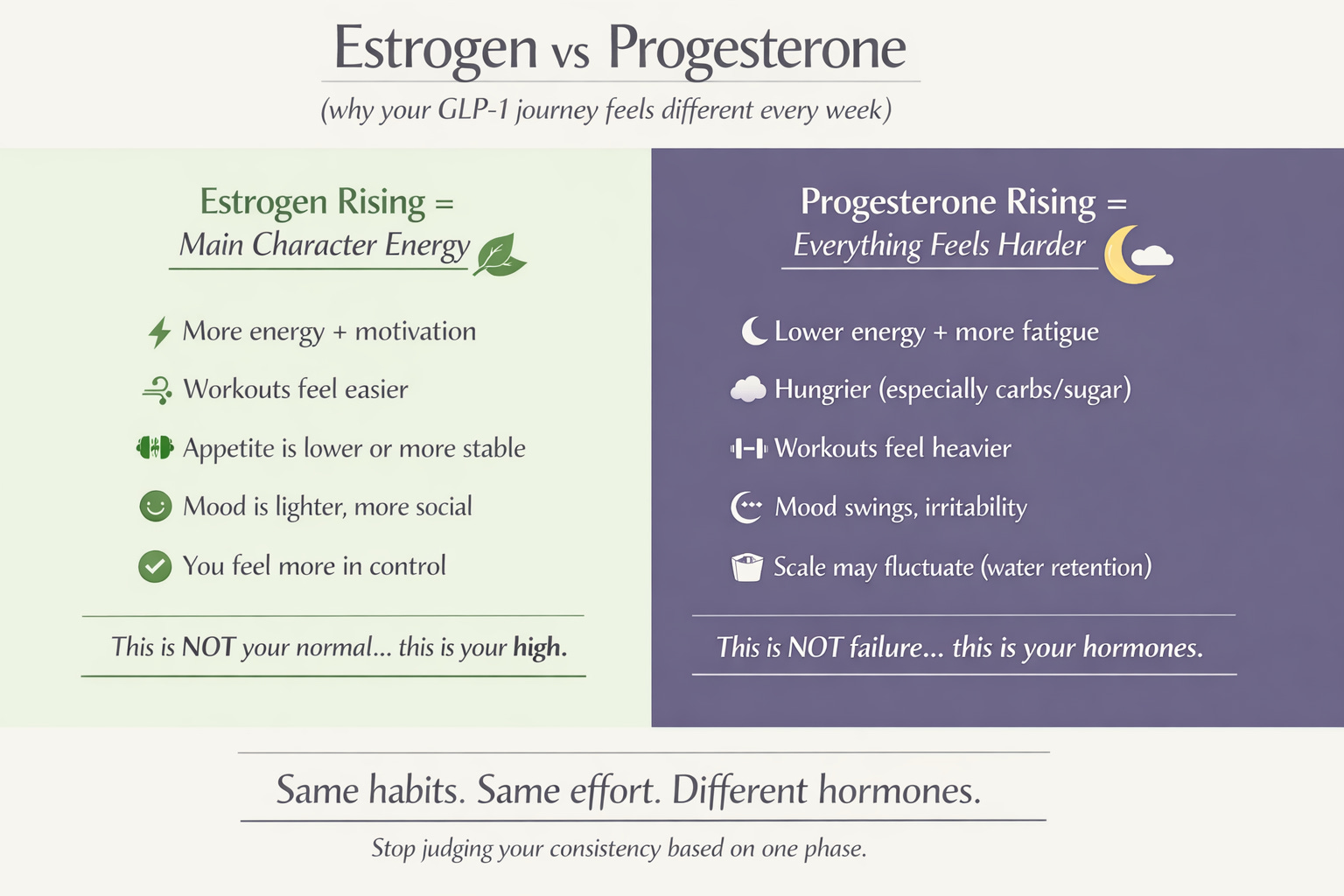
Estrogen is your feel-good hormone. When estrogen is high, your appetite is regulated, your energy is up, your mood is good, and your GLP-1 feels like it’s working at full capacity. Estrogen is essentially your GLP-1’s best friend.
Progesterone is the other side of that coin. When progesterone is high, your appetite increases, your body craves more energy (which means it wants more food), your mood can tank, fatigue sets in, and your body holds onto water like it’s preparing for something. Progesterone is loud, and during the weeks it’s dominant, it can drown out your GLP-1 entirely.
Here’s the important thing to understand: your GLP-1 does not override your hormones. It never will. Estrogen and progesterone are still going to play their roles every single month, no matter what dose you’re on. The GLP-1 isn’t broken. Progesterone is just louder right now.
So let’s break down what’s actually happening throughout your cycle.
Phase by Phase: What to Expect Every Week
Week 1: Your Period (Cycle Days 1–5)
Cycle day one is the day your period starts. During this week, both estrogen and progesterone are low, so you don’t get the great benefits of estrogen, but you also don’t get hit as hard by progesterone.
This week is kind of a wash. You might feel a little sluggish, a little bloated, a little “meh.” Your appetite could go either way. It’s hard to predict because every person’s period week looks different, but once you start tracking, you’ll start to see your own patterns really clearly.
Week 2: The Follicular Phase (Days 6–13)
This is your best week of the month, and I want you to know it so you can use it.
After your period ends, estrogen starts rising, and as it rises, you’re going to feel the shift. More energy. Better mood. Regulated appetite. This is the week your GLP-1 feels like it’s firing on all cylinders. You’re going to want to get things done, you’re going to push harder at the gym, you’re going to feel motivated and clear-headed and like yes, this is working.
This is the week to schedule the hard things. The important meetings, the challenging workouts, the things that require your best self. Your body is giving you a gift right now, use it.
Ovulation (Around Day 14)
Ovulation is short, just two to three days, but it’s when estrogen peaks. If you’ve ever noticed that you feel weirdly confident around a certain point in your cycle, like you just like the way you look, or you want to talk to people, or you feel magnetic somehow, that’s ovulation. Your confidence peaks right along with your estrogen.
It’s brief, but it’s beautiful. Enjoy it.
Week 3 & 4 — The Luteal Phase (Days 15 to your next period)
And here’s where things get tricky.
The luteal phase is the second half of your cycle, and it’s the longest part. This is when progesterone starts to rise, slowly at first, and then more significantly as you get closer to your period. And as it rises, you’re going to feel it.
Your appetite comes back. The food noise gets louder. You might be craving things (if it’s chocolate, by the way, what your body actually wants is magnesium, worth supplementing during this phase). Your energy dips. Your mood might feel heavier. And the scale? It can go up anywhere from 2 to 5 pounds during this phase purely from water retention, because progesterone causes your body to hold water.
This is the week you’re going to think your GLP-1 isn’t working. This is the week you’re going to wonder if you should dose up.
Please don’t make that call while you’re in your luteal phase.
Wait. Give it one to two weeks. Because the moment you hit your period again and roll into your follicular phase, you’re going to feel your GLP-1 kick back in, and you’ll know the medication wasn’t the problem.
What This Actually Looks Like in Real Life
I was at the gym this week doing the exact same workout I did last week. Same weights, same muscles, same everything. And it was so hard. I looked at my trainer and was like, why is this so difficult right now?
And then I remembered, I’m on cycle day 21. I’m in my luteal phase, three days before my period. I’m literally at the point in my cycle where I’m physiologically weaker. My body is doing exactly what it’s supposed to be doing.
It wasn’t that I got weaker. If anything, I should be getting stronger, I’m five weeks into consistent training. But my hormones are doing what hormones do. And knowing that? It let me forgive myself and keep going instead of spiraling.
That’s what I want for you.
A Note on Perimenopause & Menopause
If you’re thinking “but I don’t have a regular period anymore”, hormones are still playing a role in your body. They’re just more unpredictable now. You might not be able to pinpoint which phase you’re in, but the fluctuations are still happening. Tracking how you feel week to week is still incredibly valuable, because you’ll start to see patterns even when your cycle itself is irregular.
If this is already clicking for you, I’m turning this into a full Cycle Series inside my paid space.
This isn’t just one post. I’m breaking down each phase step-by-step… what’s happening, what to expect, and exactly how to adjust your food, workouts, and expectations so your GLP-1 actually works with your body.
The first deep dive is already live, and I’ll be building on it over the next few weeks.
Your Action Item: Start Tracking Your Cycle
The single best thing you can do for your GLP-1 journey right now is to start tracking your cycle.
Here’s how I do it: I have a dedicated chat in ChatGPT called “cycle tracking.” When my period starts, I tell it the date and it logs cycle day one. Then throughout the month, whenever I notice something: I’m super productive, I’m exhausted, I’m weirdly emotional, the food noise is back, I tell it. It logs the day, tells me what phase I’m in, and explains why I might be feeling that way.
What makes it even better is that over time, ChatGPT will remember your previous cycles and start connecting the dots. It’ll say, “last cycle around this day, you also felt this way.” It becomes your personal cycle historian.
I also recommend keeping a paper calendar or notebook alongside your ChatGPT tracking, so you have a visual reference you can flip back through.
When you know your cycle, you know yourself. You stop making panicked decisions. You stop second-guessing your medication. You look at your tracker and say, “Oh, I’m in my luteal phase. This is normal. I’ll wait it out.” And then when you come out the other side and your GLP-1 kicks back in, you’ll feel validated. You’ll know.
And if you come out of your luteal phase and you’re still not feeling it, then you have real information to have a conversation with your doctor about adjusting your dose. Not from a place of panic, but from a place of data.
You’re Not Failing. Your Body Is Doing Its Job.
This is not about willpower. It’s not about doing something wrong. It’s about understanding that your body is changing week by week, every single month, and your GLP-1 is working within that reality, not above it.
Have some self-compassion during the hard weeks. Lean into the good weeks. Track your cycle so you always know where you are.
You’re doing better than you think. I really mean that.
Want to go even deeper into this? I’ll be sharing my full cycle tracking guide, including examples of how I use ChatGPT to track, in a follow-up post. Stay tuned, and follow along so you don’t miss it.