

A lot of people walk into this journey with completely unrealistic expectations. And I get it. The TikToks, the before and afters, the “I lost 40 pounds in 3 months” posts. It all adds up to this idea that if you are not dropping weight fast, something is wrong with you or your medication.
But here is what is actually happening. Unrealistic expectations are setting people up to feel like they are failing when they are doing just fine. They get discouraged. They start second-guessing everything. And eventually, some people quit their GLP-1 journey altogether because they think the medication is not working.
I do not want that for you.
So today we are going deep on one question: how much weight should you actually be losing on a GLP-1? Not a guess. Not a vibe. An actual number, based on real clinical data. I call it the 20% rule, and by the end of this, you are going to walk away with your number. A realistic, grounded goal for what your next year can look like if you stay in it.
First, Let’s Look at the Research
I want to be upfront: my undergrad is in sociology, so I genuinely love data. And I went to the actual studies for this because I was not willing to just guess. The 20% rule is based on real clinical trial data from the major GLP-1 studies. This is the same data your doctor is looking at when they prescribe your medication.
The SURMOUNT-1 Trial: Tirzepatide (Mounjaro / Zepbound)
This was a 72-week study. That is a year and a half. Here is what the numbers actually looked like:
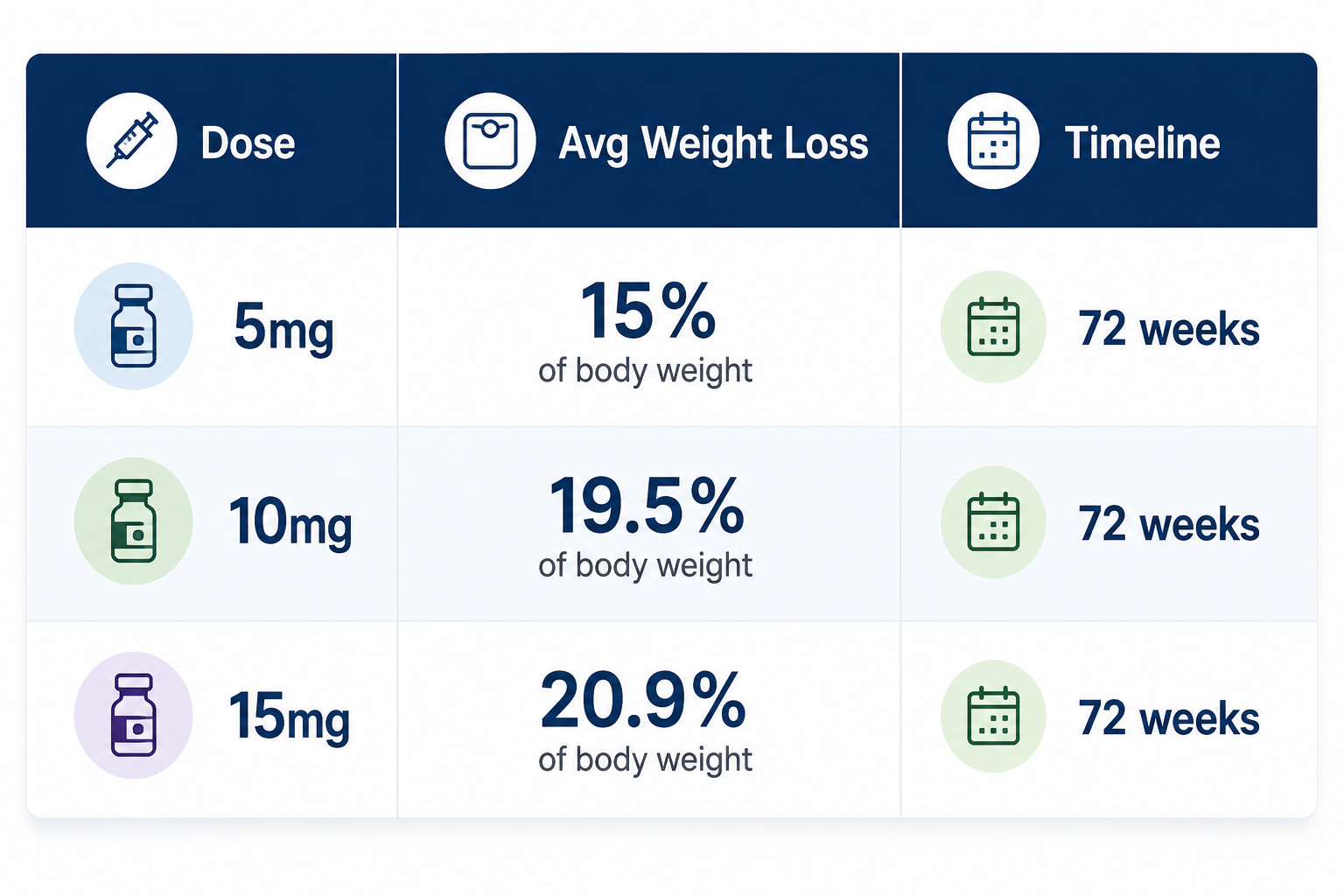
20% is possible. But that was the highest dose, over the course of more than a year, with structure and support the entire way through. And most people do not reach 15mg quickly. Some never do.
The STEP Trial: Semaglutide (Ozempic / Wegovy)
This was a 68-week study. Again, more than a year. People lost around 14.9% of their starting weight on average.
And again, this was not just people who took a shot and went home. These participants had nutrition support, movement plans, regular check-ins, structure, and a lot of accountability throughout the entire trial.
They were doing more than just the medication. And they still did not drop 50 pounds by summer.
This is the part that nobody talks about enough. The people in these trials had full support systems around them. Most of us are just out here figuring it out. So when we compare our results to the trial numbers, we need to remember the context those numbers came from.
So What Is the 20% Rule?
When I created the 20% rule, I looked at all of this data and landed on 20% as the goal because it represents what is possible at the high end of what these medications can do. It is the gold star number. It is the dream scenario.
But I need you to hear this clearly: not all of us are going to hit 20%. And that is not failure. That is normal.
If you end up at 15% instead of 20%, that is still massive. That is still life-changing. That is still worth celebrating. We need to stop treating slow and steady weight loss like it is a problem to be fixed.
Here is the realistic range to work with:
15% to 20% total weight loss over a full year is a realistic and grounded goal on GLP-1 medications
That is assuming you are consistent over time
If you are at a lower starting weight, 15% is probably the more honest number to aim for
And none of this happens in a straight line, ever
In every single trial, the people who got the best results were the ones who stuck with it, even when it was boring, even when it was slow, even when the scale stopped moving for a few weeks. Consistency is the variable that matters most.
Now Let’s Do the Math: Your Number
This is where we stop guessing and start looking at actual numbers. Math does not lie, and your number is going to tell you something really important: you are probably doing better than you think.
Here is exactly how to calculate your 20%:
Step 1: Find your 20%
Take your current weight (not your starting weight, where you are today) and multiply it by 0.20.
Current weight x 0.20 = your expected weight loss over the next 12 months
Step 2: Break it down monthly
Take that number and divide it by 12. That is your average monthly weight loss.
Total expected loss / 12 = average lbs per month
Step 3: Break it down weekly (optional)
If you want to go even further, divide your monthly number by 4. That is your average weekly number. But here is the thing. The scale is not going to move the same amount every single week. So I would encourage you to stay focused on the monthly average, not the weekly one. The weekly number will mess with your head.
A Real Example: Starting at 212 lbs
Let’s walk through this together.
212 x 0.20 = 42.4 lbs over the next 12 months
42.4 / 12 = 3.5 lbs per month on average
3.5 / 4 = about 0.9 lbs per week on average
So if you weigh 212 lbs and you are losing roughly 3.5 lbs a month, you are right on track. You are doing exactly what the data says you should be doing. Not 10 lbs a month. Not 2 lbs a week every single week. 3.5 lbs a month on average.
A Real Example: My Own Numbers
I started at 258 lbs. Here is what my 20% looked like:
258 x 0.20 = 51.6 lbs over a year
51.6 / 12 = 4.3 lbs per month
4.3 / 4 = about 1 lb per week
And that was my exact reality. I averaged about 1 lb a week during my first year. Some weeks more, some weeks nothing, some weeks the scale went up. But when I zoomed out, 1 lb per week was the average. That is where this rule came from. Not a theory. My actual life.
Why Zooming Out Changes Everything
Here is what gets most people. They lose 2 lbs one week and nothing the next week and they spiral. They think the medication stopped working. They think they broke something. They start Googling whether they need to switch medications.
But if you lost 2 lbs one week and nothing the next, you are still averaging 1 lb per week. You are still on track. You are spiraling for no reason.
The scale is going to go up and down. You might lose 10 lbs one month and 2 lbs the next. You might stall for 3 weeks and then drop 5 lbs seemingly overnight. That is not failure. That is how this actually works.
When you zoom out and look at your monthly average, and then zoom out even further and look at your 6-month or 12-month average, you will almost always find that you are right where you should be. The data is there. The progress is there. You just have to look at the right window of time.
One slow week is not failure. One slow month is not failure. Zoom out. Your body is doing something, even when the scale refuses to cooperate.
If You’re Starting at a Lower Weight
This section is specifically for the people who are starting at a lower weight or who have already lost a significant amount and are now working from a smaller number. Because this is where people really spiral, and I get a lot of messages about it.
The truth is: when you are starting at a lower weight, you are not going to see the same numbers as someone starting at a higher weight. That is not a problem. That is just math. A smaller body has less weight to lose, so the scale is going to move more slowly. That does not mean the medication is not working.
An Example at a Lower Starting Weight
Let’s look at 179.9lbs. Here is what that 20% looks like now:
179.9 x 0.20 = 36 lbs over the next 12 months
36 / 12 = 3 lbs per month on average
3 / 4 = less than 1 lb per week
Less than a pound a week. That is a realistic average.
For lower starting weights, I would encourage you to aim for 15% instead of 20%. It is more honest, and it will keep you from feeling like you are constantly falling short of something that was never realistic for your body at this stage.
If you are 3 months in and you have only lost 6 lbs at a lower starting weight, that is normal. The meds are working. Your body is adjusting. Your journey is just quieter, slower, and steadier than someone who started at 280 lbs. That is not a bad thing.
What to Do With Your Number
Now that you have your number, I want you to actually use it. Write it down somewhere you will see it. Put it in your phone. Stick it on your bathroom mirror. Because the moment you start comparing your journey to someone else’s or spiraling because the TikToks make you feel behind, I want you to come back to this.
Your number is not a magic promise. Life happens. Doses change. Stalls are real. But it is a grounded, realistic anchor point based on actual science, not someone’s highlight reel.
And here is the thing I really want you to sit with: the people in the clinical trials who got the best results were not the ones who lost the fastest in month one. They were the ones who were still there at month 12, 14, 16. They stayed in it even when it was boring. Even when it was slow. Even when the scale made them want to quit.
That is the whole game. Staying in it.
Your Homework
Before you close this, I want you to do the math. Right now. Get your number.
Take your current weight and multiply by 0.20
Divide by 12 to get your monthly average
Write it down somewhere
That number is yours. It is based on real data. It is realistic. And it is probably a lot more forgiving than the expectations you have been holding yourself to.
If you did the math and you want to share your number, drop it in the comments or the subscriber chat. I would love to cheer you on and I bet you will find others in here with the same number as you.
xo - Nyk
do you have an idea for an upcoming deep dive? Something you want me to go more into detail about? Leave it in the comments, or send me a message!
This was really helpful. I’ve been feeling discouraged because my weight loss has been slower than I expected, even though my appetite and portions have changed. Thinking about progress in percentages makes the process feel much more realistic. I’m also documenting my own postpartum Wegovy journey with PCOS, so this really resonated with me.
This is so helpful. I just realized I have been at this 9months and have lost 15.61% of my body weight. And this is without adding exercise. Feel pretty good about that! I know I have been averaging about a pound a week and that felt slow but I pretty content that it’s right where I need to be!
I am on 10mg of mounjaro and have been for 10 weeks now. I am actually considering going down a dose depending on what my doctor thinks because I have been struggling with explosive 💩 for the last 10 weeks 🤪.
But I am worried I will not lose weight if I go down