

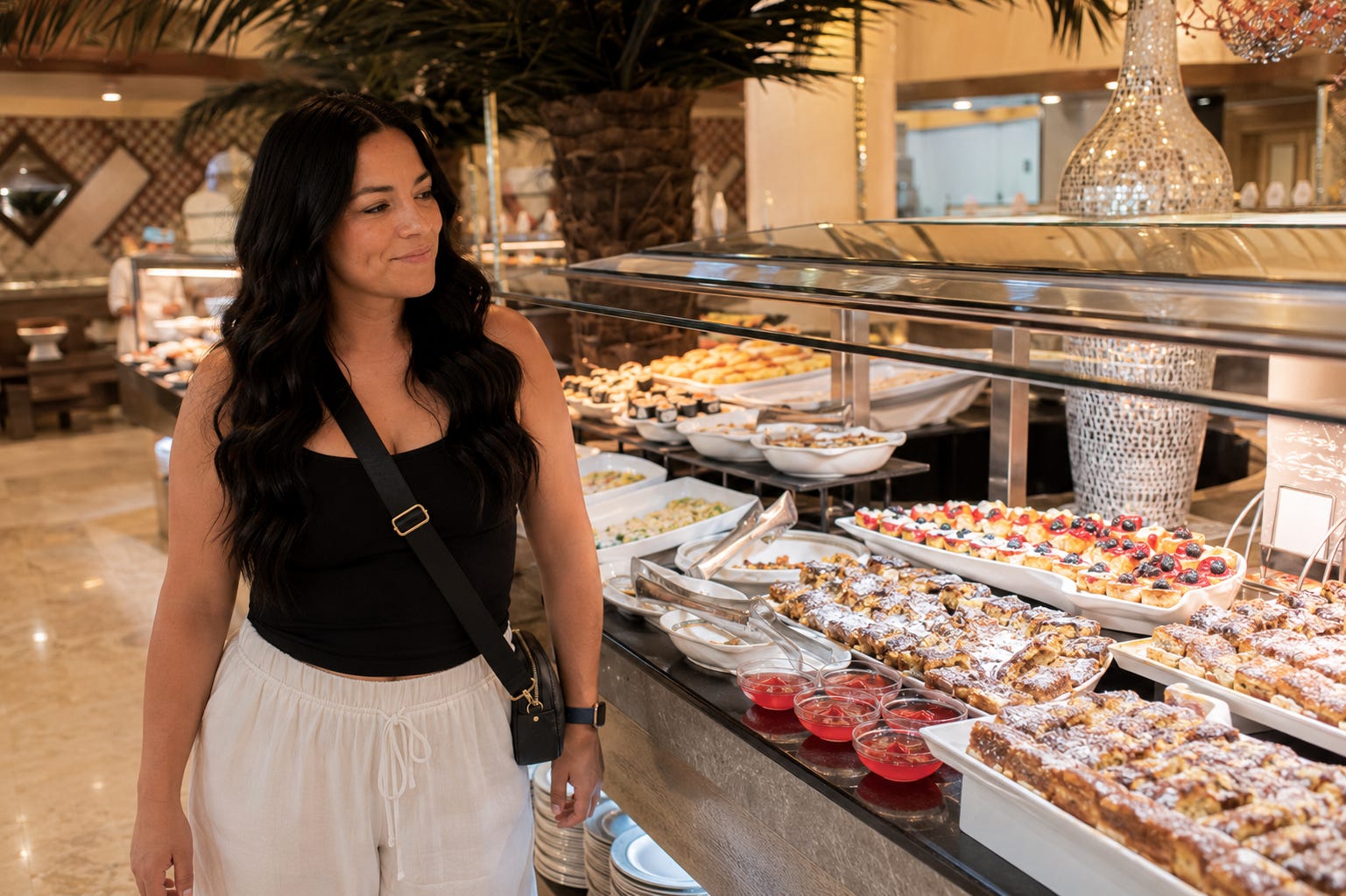
I want to go to a buffet and eat everything. Not a plate. Everything. I want to go on vacation and eat like the trip only counts if I don’t stop. I want to sit down and just keep going until the feeling in my chest that made me want to eat in the first place finally shuts up.
I can’t do that anymore. The meds stop me a few bites in, every time, whether I want them to or not.
That’s okay. It’s also true that it fucking sucks.
Nobody tells you that losing the ability to overeat is its own kind of loss. You’re supposed to just be grateful. Grateful the noise is quieter. Grateful the number’s moving. Grateful, grateful, grateful. And you are. And you also stand in front of a buffet sometimes and grieve the version of you who could disappear into a full plate and not think about anything else for twenty minutes.
I’m calling it what it is. The Great Unfeasting. And almost nobody in this community is talking about it, because admitting you miss overeating sounds like admitting you want to go backward. It’s not that. It’s grief. Those are different things, even when they feel identical from the inside.
the job the loop was actually doing
Think about what eating past full was actually covering for, for years before the meds ever showed up.
It wasn’t really about the buffet. It was the thing you reached for after a bad shift, a bad call, a bad day with your kids or your mother or your own head. It was the reward at the end of something hard, when nothing else was available and food always was. It was the one thing that worked every single time, immediately, with no waitlist and no cost you could see yet.
You weren’t overeating because you lacked discipline. You were running a coping system that had been doing a job for you since before you can probably remember building it. Stress. Boredom. Loneliness. Grief. Even celebration. The loop didn’t care what the feeling was. It just knew food would quiet it.
That’s not a character flaw. That’s a system that worked, until the cost caught up with it, and you built it because you needed something and it was there.
what actually happened in your body
Two systems used to run your eating, and only one of them was ever about food.
Homeostatic hunger is the real one. Your body needs fuel, it asks, you eat, it stops asking. This is the hunger that’s supposed to exist.
Hedonic hunger is the other one. This is the hunger that isn’t about fuel at all. It’s about reward. It’s dopamine, it’s your brain looking for somewhere to put a feeling that had nowhere else to go, and food was always available, always effective, always there.
GLP-1s go after both systems, and it happens through a few different mechanisms stacked on top of each other:
Delayed gastric emptying. The physical mechanism most people already know about. Food sits in your stomach longer, so the “stop” signal reaches your brain faster and holds longer.
Receptor activity in the reward circuitry. GLP-1 receptors aren’t only in your gut. They’re in the parts of your brain tied to dopamine and reward, the same regions activated by highly palatable food. That’s why the medication doesn’t just make you less hungry. It makes the payoff smaller too.
Neuroadaptation over time. The loop you built took years to wire in. It doesn’t unwire the moment you start the medication. Some of what you’re feeling right now, the missing it, the wanting to test it, is the old pathway still firing even though the reward at the end of it has changed. That fades. It just takes longer than the weight does.
The medication didn’t just shrink your appetite. It closed the loop you used to run to when a feeling got too big to sit with. Nobody warns you that closing the loop means grieving what the loop was for.

Check out the perks » here «
why this hits harder if food was ever the only thing that was yours
Not everyone grieves this the same amount, and there’s a reason for that.
If you grew up in a house where food was scarce, or rationed, or moralized,
“clean your plate,”
“some kids don’t have food,”
then abundance itself was loaded a long time before GLP-1 ever entered the picture. Being able to eat as much as you wanted, whenever you wanted, wasn’t just pleasure. It was proof you’d made it somewhere safer than where you started.
If you were the one who managed everyone else’s needs, the caretaker, the one who fed the household before she fed herself, food might be the one place you ever got to just take without asking anyone’s permission first.
If dieting has been the background noise of your entire life, restriction, tracking, rules, the ability to finally eat without counting anything probably felt like the first real freedom you’d had in decades, even wrapped in a habit that wasn’t serving you.
The more food was doing for you underneath the surface, the more this specific loss is going to ache. That’s not dramatic. That’s just math.
the thing nobody says about the buffet
Here’s what I actually miss, specifically, not in the abstract:
I miss walking into a spread of food and feeling like anything was possible. I miss the first few bites of a vacation meal when it still felt like the whole trip was going to be an indulgence. I miss not doing math in my head three bites in. I miss the version of relaxing that meant eating until I stopped thinking, because some days thinking was the whole problem.
None of that was healthy. I know that. Knowing it doesn’t make the missing stop.
the judgment shows up before you even name it yourself
You’ll notice people clock the change before you’re ready to talk about it.
“You barely touched your plate.”
“Are you sure that’s enough?”
“You used to be so much more fun on vacation.”
None of that is concern. That’s people missing the version of you that made food feel like a party, because your capacity for more made the whole table feel looser. You were doing something for the room by matching everyone’s energy at every meal. Nobody called it labor. They called it fun. Now that you can’t do it, some people are grieving that loss on your behalf, badly, out loud, at your expense.
You don’t owe anyone your old appetite back.
the fear underneath the relief
Here’s the part that’s harder to admit than the grief. Some of this is genuinely scary.
If food isn’t there to catch you anymore, what happens to the feeling that used to send you looking for it? If you can’t eat your way through a hard week, are you going to have to actually feel the hard week instead? If the loop is gone, who are you at the table without it?
You might be afraid you’ll turn into someone boring. Someone who orders the same three things forever, who can’t relax into a vacation, who’s no fun at a celebration anymore.
You might be afraid everyone was right, that you needed the food more than you wanted to admit, and now that it’s not an option you’re going to have to find out what’s actually underneath it.
Those fears are real. They’re also not evidence that something’s wrong with you. They’re evidence the loop was covering more ground than just hunger, and now you’re standing in the space it used to fill, figuring out what actually goes there instead.
you can hold both of these at the same time
You can be relieved you’re not white-knuckling your way through every meal anymore, and still want to walk up to a buffet one time and eat until your body forgets it has a limit.
You can love what the medication gave you and still resent it a little on the days it means saying no to a plate you actually wanted to finish.
These aren’t contradictions. They’re just what it feels like to lose a coping mechanism that used to work, even if it was never actually good for you.
what you’re actually gaining underneath the grief
You’re gaining a body that stops on its own. Not through negotiation, not through willpower you have to rebuild every single day, just an actual internal stop sign that works whether or not you’re strong enough today to listen to it.
You’re gaining nights that don’t end in the specific regret of eating past the point you were actually enjoying it. That particular kind of self-directed shame doesn’t get talked about enough, and it’s just quietly gone now.
You’re gaining a way of showing up at the table that isn’t tied to how much you consume. You get to just be there. Talk, laugh, exist, without your worth at that dinner depending on matching everyone else bite for bite.
You’re gaining time and headspace you didn’t know the loop was taking. All the mental math, the planning around the next time you’d really get to eat, the recovery from the last time, that’s bandwidth you have back now for literally anything else.
None of this cancels out the grief. It just means the grief isn’t the whole story.
what’s actually gone, and it’s allowed to hurt
the version of vacation where indulgence was the whole point of going
the identity of being the one who could always eat more, want more, go back for seconds without a second thought
the numbing. the twenty minutes food used to buy you where you didn’t have to feel anything else
the specific joy of a buffet feeling like it was made for you
You’re allowed to grieve all of it without wanting a single bit of it back in practice.
what doesn’t survive this, and that’s information not tragedy
Some traditions were never really about the company. They were about the volume. The friend who only wanted to go out to eat because you’d match her plate for plate. The family gathering where your role was eating enough that nobody else felt watched. The relationship where food was the third person at every date, doing the emotional work neither of you wanted to do out loud.
When you stop being able to do that, one of two things happens. The relationship or tradition becomes about something real, actual conversation, actual connection, or it quietly falls away because the food was the only thing holding it together in the first place.
Losing that isn’t loss. It’s just finding out what was actually there underneath the eating the whole time.
how to actually sit with this instead of pushing through it
Name it out loud, even just to yourself. “I’m not demoted to boring, I’m grieving a coping mechanism that used to work.” The story you tell yourself about this changes how much it costs you to feel it.
Let the fear be there without believing it’s a fact. Being scared you’ll be boring without the loop doesn’t mean you will be. It means you’re in the part where you haven’t found the replacement yet.
Don’t rush to replace it with something else that just does the same numbing job. Rest, a walk, a call to someone who gets it, that’s not the same as swapping one loop for a smaller one.
Let it be inconvenient that you’re grateful and grieving in the same week. Don’t pick one to perform for other people.
Find people who’ll admit they miss it too. This community exists so you don’t have to carry that admission alone.
you’re not losing your appetite for life. you’re losing the substitute for it.
The version of you that could disappear into a full plate for twenty minutes wasn’t more alive than the version of you sitting here right now, feeling all of this without anywhere to put it. She was just better at not feeling it.
This isn’t you becoming smaller, or boring, or less fun. It’s you finally being present for a meal, a vacation, a hard week, without a loop absorbing the parts that were too much to feel. That’s harder. It’s also the actual thing you’ve been working toward this whole time, even on the days it doesn’t feel like a win.
what’s the thing you miss the ability to do, even though you know you don’t actually want to do it again? tell me. buffet, vacation, the whole plate, whatever it is. I have a feeling I’m not the only one standing in front of a dessert table missing who I used to be there.
it fucking sucks sometimes. and you’re still doing this right.
Nyk.
Thank you for talking about this. It is real. And on the weeks where it is paired with a small loss…or no loss…or a gain…it gets louder. I do find myself wondering when I will make my peace with it. What I find I miss is the fun. The social piece. Planning an entire day or vacation around where I’m going to eat. I miss being excited about food.
I miss going to bed on a full stomach. The almost too full feeling was my calm, my appetizer to sleep. I now do not eat past 8 no matter what, no more late night snacks. The other things I miss are sweets. They now make me feel nauseous. There is something about a cinnamon roll and a cup of coffee that makes the day feel special. I am working through it. I was raised to finish your plate, if not you ate it at the next meal. I used food for happy, sad, excited, to celebrate, you get it …. Food was everything. It does feel like loss. I can tell you all but even my family would think I am crazy if I said something g like that.