

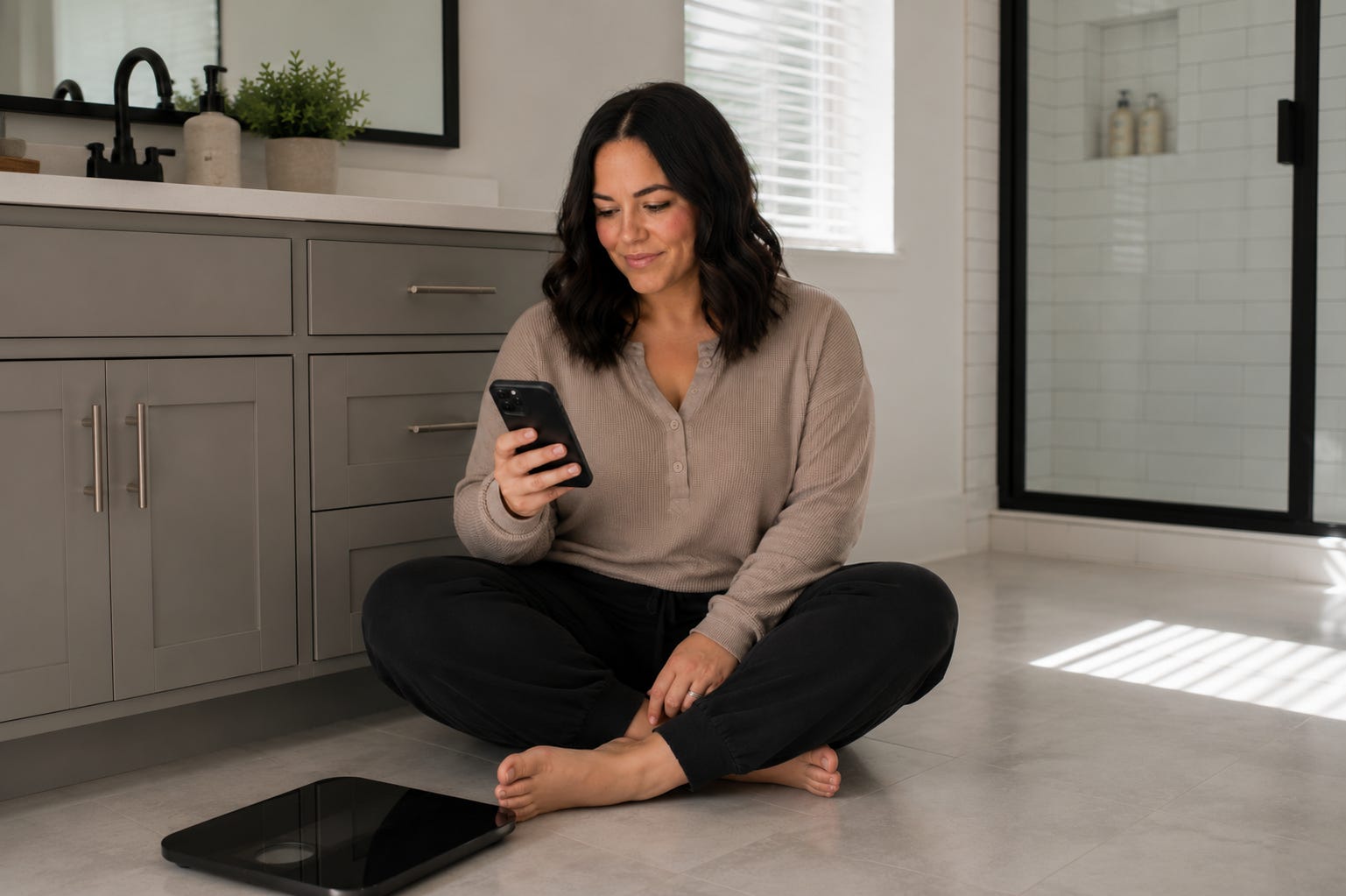
You stepped on the scale this morning already bracing for it.
Maybe you did everything right this week. Maybe you didn’t. Either way, some part of you had already decided what the number was going to say before you even looked down. And when it said something worse than what you expected, your brain went straight to the story it already knows by heart: you failed. You slipped. You’re the problem.
Here’s the thing nobody explained to you before they handed you a scale and told you it was the whole truth.
The scale is not measuring fat. It has never measured fat. What it measures is total mass in your body at one single moment, and that number is being pulled around by at least nine other things that have nothing to do with whether you are actually losing weight. Call it Scale Static. It’s the noise your body makes while the real work is happening underneath it, and most people have never been taught to hear the difference.
Here are nine forms of Scale Static, and what’s actually going on when the number moves and your effort didn’t change at all.
1. Sodium is holding onto water for dear life
Your body doesn’t process sodium and just move on. Sodium pulls water into your bloodstream and tissues to keep your blood concentration balanced, and it can hang onto that water for days. One salty meal, one dinner out, one bag of chips at 9pm, and your body is quietly storing extra water to dilute it.
What this looks like → you ate out Friday night, felt totally fine, and Saturday morning the scale is up two pounds. That’s not two pounds of anything you ate. That’s water your kidneys haven’t released yet.
2. Carbs are stored with water attached
Every gram of carbohydrate your body stores as glycogen comes with roughly three grams of water bound to it. Eat more carbs than usual, even healthy ones, and your body stores more glycogen, which means it’s storing more water right along with it.
What this looks like → a bigger pasta night, a higher carb weekend, a return from a low carb stretch back to normal eating. The scale jumps and it has nothing to do with fat gained overnight, because that is biologically not possible in 24 hours.
3. Your cycle is doing exactly what it’s supposed to do
In the days before a period, estrogen and progesterone shift in ways that cause the body to retain water, sometimes as much as five pounds worth. This is not a flaw in your tracking. It’s a completely normal hormonal pattern that repeats every single month whether you’re doing everything right or not.
What this looks like → the scale creeps up starting a week before your period, peaks right before it starts, and drops on its own once your cycle begins. Same effort, different number, every month.
4. What’s in your digestive system is on the scale too
The scale doesn’t know the difference between fat and food that hasn’t moved through you yet. Whatever is currently sitting in your stomach and intestines, waiting to be digested, gets weighed right along with everything else.
What this looks like → you ate a big dinner and weighed yourself the next morning before things had fully moved through. That weight is real, it’s just temporary, and it has nothing to do with your progress.
5. Stress is quite literally making you retain water
Cortisol, your primary stress hormone, affects how your kidneys manage sodium and fluid balance. Chronically high stress can lead to your body holding onto more water than it would otherwise, independent of anything you ate.
What this looks like → a brutal week at work, a hard conversation with someone you love, a deadline that ate your sleep. None of that shows up as a mood on the scale. It shows up as water weight, and it gets blamed on your food choices instead.
6. You didn’t drink enough water, so your body is hoarding what it has
This one feels backwards, but it’s real. When you’re dehydrated, your body senses a threat to its fluid balance and starts holding onto every drop of water it has access to, as a protective measure.
What this looks like → a day you barely drank anything, followed by a scale number that doesn’t move down the way you expected, or even ticks up. Your body isn’t punishing you. It’s protecting itself.
7. Your muscles are repairing themselves, and repair needs water
A hard workout creates microscopic tears in muscle tissue, and the repair process pulls water into those muscles to support healing and rebuilding. This is a sign your training is working, not a sign it isn’t.
What this looks like → you had your best workout in weeks, felt strong, and the scale went up the next day. That’s inflammation from repair, not fat, and it usually resolves within 48 to 72 hours.
8. A dose change can bring temporary water shifts with it
Starting or increasing a GLP-1 dose can come with short term changes in digestion, fluid balance, and inflammation while your body adjusts. This is common and it’s not a sign that something is wrong.
What this looks like → you just moved up a dose and the scale is doing something unpredictable for a week or two. Give your body time to settle before you read anything into that number.
9. You built muscle, and muscle takes up less room than it weighs in fear
If you’ve been adding protein and any kind of resistance movement, some of what’s shifting is body composition, not just body mass. Muscle is denser than fat, so the scale can stay flat or even go up slightly while your body is actually changing shape underneath it.
What this looks like → your clothes fit differently, someone comments that you look different, and the scale insists nothing has happened. The scale is not lying. It’s just not equipped to see this part.
None of this means the scale is useless. Trends over weeks still matter. But a single number on a single morning was never built to hold the whole truth of what’s happening in your body, and treating it like a verdict is where the shame creeps in.
Both things are true at once. The scale can be an honest data point over time, and it can also be completely misleading on any given day. You’re allowed to track your weight and also refuse to let one morning define how the day goes.
So next time the number does something you didn’t expect, before your brain goes straight to blame, ask yourself what it might actually be measuring today. Sodium. Carbs. Your cycle. Stress. A dose change. A hard workout. Muscle you built.
What’s the scale actually been lying to you about lately?
still gathering data, not assigning morality.
Nyk.
New here?? » Not sure where to start? Check out my Start here Page first. It walks you through everything before you dive in.


Ready to start your own GLP-1 journey? I get my medication through Elara. Right now they're offering a free month on any six month plan. That brings Tirzepatide down to $193 a month and Semaglutide down to $115 a month. Use code TIRZFREE for Tirzepatide or SEMAFREE for Semaglutide » Start


I am only going to weigh once every 3 weeks - the scale is not kind to me !
Stress is it for me this week. School started with tracking expectations for 100 students and 5 SPED teachers case loads. We will see what tomorrow brings but right now I gained 2.5 pounds on Thursday. Ugh, my new focus for the next couple of weeks is to manage my stress and not allow it to overwhelm me!